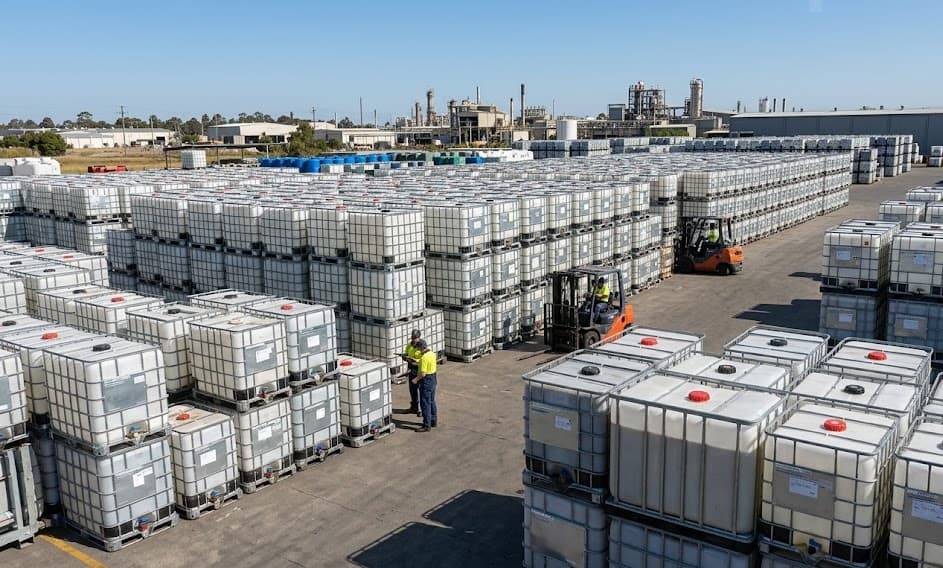
IBC Totes for Manufacturing
Streamline your production floor with bulk liquid storage that saves space, reduces handling, and cuts packaging costs compared to traditional 55-gallon drums.
Get a Free Quote
The Manufacturing Advantage
Manufacturing facilities consume vast quantities of liquid materials, from metalworking coolants and hydraulic oils to cleaning solvents and raw chemical ingredients. Traditional 55-gallon drums create bottlenecks: frequent changeovers, excessive handling labor, higher spillage risk, and wasted floor space. IBC totes eliminate these inefficiencies. A single 275-gallon tote holds five times the volume of a drum while taking up 35% less floor space. The integrated pallet base, forklift pockets, and bottom-discharge valve reduce handling time per gallon by up to 80%. For Cleveland-area manufacturers looking to lean out their operations, switching from drums to IBC totes is one of the simplest high-impact improvements available.
12 Manufacturing Applications
IBC totes serve dozens of applications across the manufacturing sector. Here are twelve of the most common uses that Cleveland-area manufacturers rely on every day.
Metalworking Coolants
CNC machines, lathes, and milling centers consume thousands of gallons of cutting fluid and coolant each year. IBC totes serve as central coolant reservoirs that feed automated mixing systems, reducing downtime from drum changeovers and minimizing waste from partially empty containers.
Lubricants & Hydraulic Fluids
Hydraulic presses, injection molding machines, and assembly line equipment require consistent access to lubricants and hydraulic oils. Storing these fluids in IBC totes instead of drums means fewer container changes, less risk of contamination during transfer, and simplified inventory management.
Cleaning Solvents
Parts washers, degreasing stations, and surface preparation lines use bulk quantities of cleaning solvents. IBC totes with bottom-discharge valves can be plumbed directly into solvent delivery systems, eliminating manual pouring and reducing worker exposure to volatile chemicals.
Adhesives & Resins
Manufacturers of composite materials, coatings, and bonded assemblies use IBC totes to store and dispense adhesives, epoxy resins, polyurethane precursors, and hardeners. Heated totes maintain viscosity for temperature-sensitive products.
Paints & Coatings
Automotive, aerospace, and industrial coatings manufacturers store base paints, primers, clear coats, and thinners in IBC totes. The sealed system prevents solvent evaporation and maintains batch consistency.
Raw Material Ingredients
Liquid raw materials including plasticizers, process water, dyes, and chemical intermediates are efficiently received and stored in IBC totes, streamlining incoming logistics and production scheduling.
Coolant Concentrate Management
Centralized coolant management systems use IBC totes as master reservoirs for coolant concentrate. Automated proportioning equipment draws from the tote and mixes coolant to the correct ratio before distributing it to individual machines via piping. This eliminates the inconsistent mixing that occurs when operators mix coolant at each machine from drums.
Waste Fluid Collection
Spent coolant, used solvents, waste oils, and contaminated rinse water are collected in IBC totes before pickup by waste haulers. Using totes instead of drums for waste collection reduces handling events, simplifies waste tracking, and provides a sealed system that prevents evaporation of volatile waste components.
MRO Supplies Storage
Maintenance, repair, and operations supplies including rust preventatives, penetrating oils, cutting fluids, way oils, and machine cleaners are stored in IBC totes in the maintenance shop. The bottom valve allows controlled dispensing into smaller containers for point-of-use application.
Printing Inks & Solvents
Printing operations use large volumes of inks, fountain solutions, blanket wash, and roller wash. IBC totes provide sealed bulk storage that prevents evaporation, maintains ink quality, and feeds directly into ink pumping systems on press lines.
Wastewater Treatment Chemicals
Manufacturing facilities with on-site wastewater treatment use IBC totes to store pH adjustment chemicals, flocculants, polymer coagulants, and nutrient removal chemicals. The totes connect directly to chemical metering pumps for automated dosing.
De-Icing & Anti-Freeze Solutions
Manufacturing facilities with large outdoor areas, loading docks, and parking lots store bulk de-icing solution and anti-freeze in IBC totes. The bottom valve simplifies dispensing into spreaders and sprayers during winter weather events.
Lean Manufacturing & IBC Optimization
For manufacturers committed to lean principles, IBC totes are a natural fit. They directly address multiple forms of waste identified in the Toyota Production System and support key lean methodologies. Here is how IBC totes align with core lean manufacturing principles.
Eliminate Waste (Muda)
IBC totes eliminate seven forms of waste in liquid handling: overproduction (bulk buying reduces ordering frequency), waiting (fewer changeovers means less downtime), transport (one move replaces five), overprocessing (direct plumbing eliminates manual pouring), inventory (better visibility of remaining volume), motion (forklift-friendly design reduces walking), and defects (sealed transfer reduces contamination).
Continuous Flow
IBC totes enable continuous-flow liquid supply to production lines. A 275-gallon tote lasts 5x longer than a drum, meaning fewer interruptions to production flow. For high-consumption operations, two totes can be manifolded together so one drains while the other is replaced, achieving zero-interruption flow.
Pull System
IBC totes support pull-based replenishment. The transparent or translucent HDPE bottle allows visual level monitoring. When the level drops to a predetermined point, a replacement tote is staged. This kanban-style approach prevents both stockouts and excess inventory.
Level Production (Heijunka)
Standardizing on IBC totes across all liquid inputs simplifies receiving, storage, and handling procedures. Every liquid comes in the same container format, uses the same forklift attachments, and fits in the same storage footprint. This standardization smooths material flow and reduces complexity.
5S Workplace Organization
IBC totes support 5S implementation in liquid storage areas. Their uniform shape allows neat, organized arrangement (Sort/Set in Order). Sealed containers prevent spills and drips (Shine). Standardized labeling and color coding maintain order (Standardize). And their durability supports long-term organization (Sustain).
Just-in-Time Delivery Benefits
IBC totes enable just-in-time delivery of liquid materials that was impractical with drum-based systems. Cleveland IBC Recycling offers scheduled recurring delivery programs that align with your production consumption rates, reducing both inventory carrying costs and stockout risk.
Reduced Inventory Holding Costs
IBC totes hold 5x the volume of a drum in a smaller footprint. This means you can store more liquid in less space, or maintain the same supply with fewer containers occupying less floor space. For manufacturers paying per-square-foot for warehouse space, this translates directly to reduced holding costs.
Fewer Purchase Orders
Ordering 10 IBC totes instead of 50 drums reduces purchase order frequency by 80%. Fewer POs mean less procurement labor, fewer receiving events, fewer invoices to process, and fewer opportunities for ordering errors.
Predictable Replenishment Cycles
Because each IBC tote lasts 5x longer than a drum, replenishment timing is more predictable. This makes it easier to implement just-in-time delivery schedules that align with production consumption rates, reducing both stockout risk and excess inventory.
Supplier Consolidation
Many chemical and fluid suppliers prefer to ship in IBC totes because they are more efficient than drums. Switching to totes may allow you to consolidate suppliers and negotiate better pricing based on bulk purchasing in tote quantities.
IBC Totes vs. 55-Gallon Drums
The numbers tell the story. Switching from drums to IBC totes reduces handling labor, floor space requirements, spillage risk, and per-gallon container costs across every metric that matters to manufacturers.
| Metric | 55-Gallon Drum | IBC Tote |
|---|---|---|
| Capacity | 55 gallons | 275-330 gallons |
| Containers per 275 gal | 5 drums | 1 tote |
| Floor Space (275 gal) | ~25 sq ft | ~16 sq ft |
| Handling Events | 5 lifts, 5 pours | 1 lift, 1 connection |
| Forklift Compatible | Requires drum handler | Built-in pallet base |
| Stackable | Limited / risky | Yes, up to 2 high |
| Bottom Discharge | No (requires pump/siphon) | Yes (2" butterfly valve) |
| Spillage Risk | Higher (open-top pouring) | Lower (closed-system transfer) |
| Product Waste (residual) | 2-3 gal per drum | Less than 1 gal per tote |
| Labels to Track | 5 per 275 gal | 1 per 275 gal |
| Receiving Time | 15-20 min for 5 drums | 3-5 min for 1 tote |
Floor Space Optimization
Manufacturing floor space is expensive. Every square foot used for liquid storage is a square foot not available for production equipment, workstations, or finished goods staging. IBC totes dramatically reduce the floor space needed for liquid storage compared to drum systems.
Small Machine Shop (5 CNC machines)
Drums: 20 drums of coolant, 10 drums of hydraulic oil, 5 drums of solvent = 35 drums
Drum Space: ~175 sq ft of floor space + aisle access
Totes: 4 totes of coolant, 2 totes of hydraulic oil, 1 tote of solvent = 7 totes
Tote Space: ~112 sq ft of floor space + aisle access
36% floor space reduction
Medium Metal Fabrication (20 machines)
Drums: 80 drums of various fluids
Drum Space: ~400 sq ft + aisles
Totes: 16 totes of various fluids
Tote Space: ~256 sq ft + aisles
36% floor space reduction, stackable for up to 50% savings
Large Automotive Parts Manufacturer
Drums: 200+ drums in active use
Drum Space: ~1,000 sq ft + aisles + drum storage area
Totes: 40 totes in active use
Tote Space: ~640 sq ft + aisles, stackable
36-50% floor space reduction
Detailed Cost Analysis
The total cost of ownership for IBC totes is dramatically lower than drums when you account for container cost, handling labor, product waste, disposal, floor space, and spill cleanup. The following analysis is based on a mid-size manufacturing facility using approximately 5,500 gallons of various fluids per month.
| Cost Category | 55-Gallon Drums | IBC Totes | Annual Savings |
|---|---|---|---|
| Container Cost (per 275 gal) | $325-425 (5 drums) | $75-150 (1 used tote) | $2,500-5,000 |
| Handling Labor (per changeover) | 25-30 min (5 drums) | 5 min (1 tote) | $3,000-6,000 |
| Product Waste (residual per 275 gal) | 10-15 gallons | Less than 1 gallon | $1,000-3,000 |
| Disposal Cost (empty containers) | $3-5 per drum | Free pickup by us | $500-1,500 |
| Floor Space (per 275 gal stored) | 25 sq ft | 16 sq ft | Varies by location |
| Spill Cleanup (annual average) | $500-2,000 | $100-300 | $400-1,700 |
Estimated Total Annual Savings: $7,500 - $17,200
Based on a mid-size manufacturer using ~5,500 gallons/month of various fluids. Actual savings vary by facility size, fluid types, and current procurement costs.
Coolant Management
Metalworking coolant is often the single largest liquid expenditure for machine shops and metal fabrication facilities. IBC totes transform coolant management from a labor-intensive, waste-heavy process into a streamlined, cost-efficient system.
Centralized Coolant Systems
Modern manufacturing facilities use centralized coolant management systems where IBC totes serve as the master concentrate reservoir. An automated proportioner draws concentrate from the tote, mixes it with water to the correct ratio (typically 5-10% concentrate), and distributes the mixed coolant to individual machines through a piping network. This approach ensures consistent coolant concentration across all machines, reducing tool wear and improving surface finish quality.
Coolant Life Extension
IBC totes extend coolant life by reducing contamination. Unlike drums, which require open-top pouring that introduces dirt, debris, and bacteria, IBC totes deliver coolant through a sealed, closed-system connection. Reduced contamination means coolant lasts longer before needing replacement, saving both material and disposal costs.
Tramp Oil Management
Spent coolant collected in IBC totes can be processed through oil/water separators to remove tramp oil before the coolant is either recycled or disposed of. The large volume of an IBC tote makes it practical to batch-process spent coolant rather than dealing with individual drums, improving the efficiency of your tramp oil management program.
Coolant Recycling
Some facilities recycle spent coolant by filtering, re-fortifying with concentrate, and reusing it. IBC totes are ideal for this process because they can serve as collection, processing, and redistribution vessels. A three-tote system (collection, processing, clean storage) creates a continuous coolant recycling loop that reduces both fresh coolant purchases and waste disposal costs.
Paint & Coatings Applications
The paint and coatings industry is one of the largest consumers of IBC totes in manufacturing. From base paints to thinners, from adhesive primers to clear coats, IBC totes offer sealed, contamination-free storage that maintains product quality and simplifies production floor logistics.
Solvent Recovery
IBC totes store recovered solvents from distillation units. The sealed container prevents evaporation losses and maintains solvent purity for reuse. A dedicated tote for each solvent type prevents cross-contamination.
Color Management
Paint manufacturers use separate IBC totes for each base color, tint, and additive. The clear or translucent HDPE bottle allows visual monitoring of remaining volume, and the sealed system prevents skinning, contamination, and evaporation.
Spray Line Supply
IBC totes can be plumbed directly into automated spray lines using the bottom discharge valve and a pump system. This eliminates the manual drum-to-tank transfers that introduce inconsistency and contamination into the coating process.
Environmental Compliance for Manufacturers
Manufacturing facilities are subject to multiple environmental regulations that directly affect how IBC totes are stored, used, and managed. Here are the key compliance areas that Cleveland-area manufacturers should be aware of.
Hazardous Waste Management
Manufacturing facilities generating hazardous waste must store it in containers that meet EPA RCRA requirements (40 CFR 262/264/265). IBC totes used for hazardous waste must be in good condition, compatible with the waste, properly labeled with the words "Hazardous Waste" and the accumulation start date, and kept closed except during active filling. Satellite accumulation areas near the point of generation are limited to 55 gallons in drums or one quart; however, a 90-day storage area can hold multiple IBC totes of hazardous waste.
Air Emissions Control
VOC-containing liquids stored in IBC totes may be subject to air emissions regulations under the Clean Air Act and Ohio EPA air permits. The sealed design of IBC totes significantly reduces evaporative losses compared to open-top drums, which can actually help facilities stay below emissions thresholds that would trigger additional permitting requirements.
Stormwater Compliance
IBC totes stored outdoors are subject to stormwater management requirements under the Clean Water Act NPDES program. Totes containing chemicals must be covered or stored in areas where stormwater runoff cannot contact the containers. Secondary containment areas must be managed to prevent contaminated stormwater from reaching storm drains or surface water.
Spill Prevention (SPCC)
Facilities storing more than 1,320 gallons of oil (including lubricants, hydraulic fluids, and coolants) in aboveground containers must have a Spill Prevention, Control, and Countermeasure (SPCC) plan. Five IBC totes of oil exceed this threshold. The SPCC plan must include secondary containment provisions, inspection schedules, and employee training requirements.
Upgrade Your Production Floor
Cleveland IBC Recycling works with manufacturers across Northeast Ohio to replace inefficient drum systems with cost-effective IBC tote solutions. Contact us for a free assessment of your liquid storage needs and a custom quote.
We offer volume pricing for manufacturers, scheduled recurring delivery programs, free pickup of empty totes, and expert guidance on container selection for your specific applications. Let us show you what lean liquid management looks like.