Frequently Asked Questions
Comprehensive answers to the most common questions about IBC totes � buying, selling, recycling, food safety, delivery, and more.
Get a Free Quote
IBC Basics
What is an IBC tote?
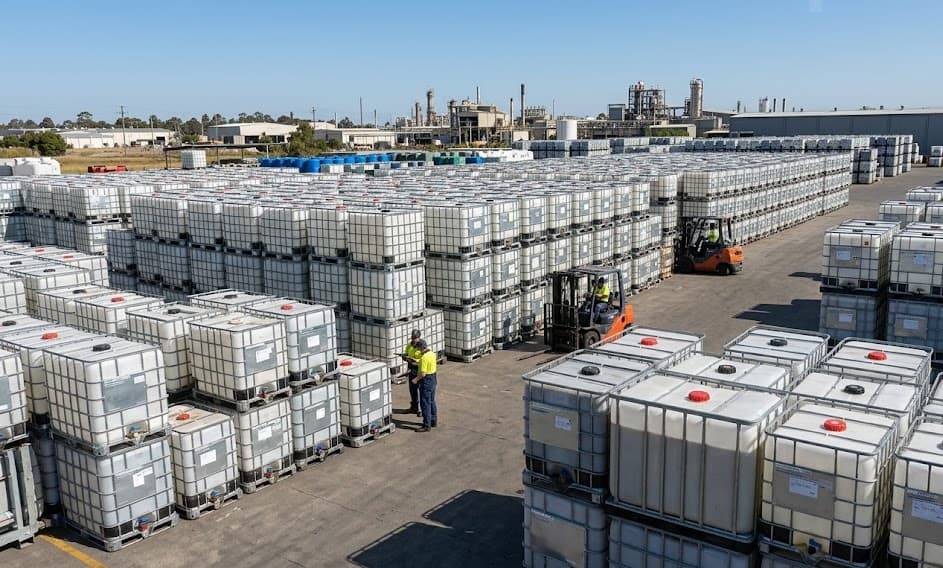
An IBC (Intermediate Bulk Container) tote is a reusable industrial container designed for storing and transporting bulk liquids and granular materials. The most common type is a composite IBC, which features a blow-molded HDPE (high-density polyethylene) inner bottle enclosed in a galvanized steel cage mounted on a pallet base. Standard capacity is 275 gallons (1,041 liters), though sizes range from 110 to 550 gallons. IBCs are used across virtually every industry � food and beverage, chemical manufacturing, agriculture, pharmaceuticals, and more. A single 275-gallon IBC replaces approximately five 55-gallon drums while using roughly the same floor space.
How long does an IBC tote last?
The lifespan depends on the component and usage conditions. The HDPE bottle typically lasts 3�5 years before UV degradation and chemical exposure reduce its integrity. The steel cage can last 10+ years and can be re-used through multiple bottle replacements (a process called "rebottling"). The pallet lasts 5�10 years for wood, longer for composite. For UN-certified hazmat transport, composite IBCs have a strict 5-year service life from the date of manufacture. For non-hazmat storage and transport, totes can be used indefinitely as long as they remain structurally sound and free of leaks.
What is the difference between an IBC tote and an IBC tank?
There is no difference � "IBC tote," "IBC tank," "IBC container," and "tote tank" are all names for the same product. "Tote" is the most common term in North America, while "IBC" or "IBC container" is used more internationally. Some people use "IBC tank" specifically for metal (steel or stainless) IBCs, but this is not a standardized distinction. In the recycling and reconditioning industry, "tote" is the standard shorthand.
What sizes do IBC totes come in?
Standard IBC tote sizes are 110 gallons (416 L), 275 gallons (1,041 L), 330 gallons (1,249 L), and 550 gallons (2,082 L). The 275-gallon size is by far the most common, accounting for over 80% of all composite IBCs in circulation. It sits on a standard 48" � 40" pallet and integrates with standard logistics systems. The 330-gallon uses the same footprint but is taller. Visit our Size Guide for complete dimensions, weights, and specifications for every size.
Buying IBC Totes
What grades of used IBC totes do you sell?
We typically offer three grades of used IBC totes. Grade A totes are in excellent condition � clean inside, minimal cosmetic wear on the cage, fully functional valve, and intact labels. These previously held food-grade or non-staining materials. Grade B totes are structurally sound with moderate cosmetic wear � some cage scuffing, minor label residue, and light interior staining that does not affect functionality. Grade C totes show significant wear � heavier staining, some cage dents, and may need valve or gasket replacement � but are still leak-free and functional for non-critical applications like water storage, rainwater collection, or agricultural use.
How much does a used IBC tote cost?
Pricing varies by grade, condition, and quantity. As a general range: used Grade A totes run $75�$125, Grade B totes $50�$90, and Grade C totes $30�$60. Reconditioned totes (professionally cleaned with new valves and gaskets) typically cost $100�$200. New composite IBCs range from $200�$350. Stainless steel IBCs are $1,500�$4,000+ new. Volume discounts are available for orders of 10+ units. Prices fluctuate with supply and demand � contact us for current pricing.
Can I buy food-grade IBC totes?
Yes. We stock food-grade IBC totes that have only been used to store FDA-compliant food products such as juices, liquid sweeteners, vegetable oils, and flavorings. Food-grade totes are never cross-used with non-food materials. We also offer professionally reconditioned food-grade totes that have been triple-rinsed, sanitized, and inspected for food safety. For applications requiring virgin (never-used) containers, we sell new IBC totes made from FDA-compliant HDPE resin. Always verify that the tote's previous contents are compatible with your intended use.
What is the minimum order quantity?
There is no minimum order � we sell individual totes for small operations and homeowners, and we supply truckloads for industrial buyers. That said, per-unit pricing improves with volume. A full truckload holds approximately 56�60 empty IBCs (stacked and nested), which is the most cost-effective way to purchase large quantities. For deliveries of 1�10 totes in the Greater Cleveland area, we offer flexible delivery scheduling.
Selling & Recycling
Will you buy my used IBC totes?
Yes � we actively purchase used IBC totes from businesses across Northeast Ohio and beyond. We buy totes in all conditions, from clean single-use food-grade containers to heavily used industrial totes. Pricing depends on the condition, quantity, previous contents, and whether we need to arrange pickup. Clean, food-grade totes in good condition command the highest buyback prices. Even damaged totes have value � we recycle the HDPE and steel components. Contact us with your quantity, general condition, and previous contents for a quote.
Do you offer free pickup for IBC totes?
We offer free pickup for quantities of 10 or more IBC totes within our primary service area (Greater Cleveland and most of Northeast Ohio). For smaller quantities or locations outside our core area, a nominal transportation fee may apply. We can often combine pickups to reduce costs � if you're in a location near one of our regular routes, we may be able to offer free pickup for smaller quantities. Our trucks are equipped to handle full or empty totes, and we handle all loading. Contact us to discuss your specific situation.
What happens to totes that can't be reused?
Every IBC we collect is processed through our zero-landfill system. Totes that can't be reconditioned for reuse are completely disassembled and the materials are recycled separately. The HDPE bottle is shredded and sent to plastic recyclers who convert it into pellets for manufacturing new products (pipe, lumber, containers). The galvanized steel cage is processed as scrap steel. Wood pallets are repaired and reused, or chipped for mulch and biomass fuel. Even the valve components are separated by material type for recycling. Nothing goes to the landfill.
How does IBC recycling help the environment?
Recycling a single 275-gallon composite IBC keeps approximately 118 lbs of material out of landfills � including about 35 lbs of HDPE plastic and 75 lbs of steel. Manufacturing new HDPE from recycled material uses 88% less energy than virgin production. Recycled steel requires 74% less energy than producing new steel from iron ore. When you factor in avoided landfill methane emissions, reduced mining and drilling for raw materials, and decreased transportation of virgin materials, recycling IBCs delivers substantial environmental benefits. By choosing recycled or reconditioned totes, businesses reduce their Scope 3 carbon emissions in a measurable way.
Delivery & Logistics
What areas do you serve for delivery?
Our primary service area covers Greater Cleveland, Akron, Canton, Youngstown, Lorain, Elyria, Mentor, and most of Northeast Ohio. We also make regular deliveries to Columbus, Toledo, Pittsburgh (PA), and Erie (PA). For large orders (full truckloads), we can arrange delivery anywhere in the continental United States through our freight partners. Local deliveries are typically made with our own trucks, which are equipped with liftgates and forklifts for ground-level drop-off.
How are IBC totes delivered?
IBC totes are delivered on flatbed trucks or enclosed trailers, depending on the quantity and your facility requirements. Our trucks carry onboard forklifts for ground-level delivery to locations without dock access. Empty totes can be stacked 2-3 high on the truck. Full totes are delivered on a single level and secured with strapping. For dock-height facilities, we deliver on standard trailers. We work with your team to schedule delivery times that minimize disruption to your operations. Delivery typically occurs within 2-5 business days of order confirmation for in-stock items.
Food Safety & Compliance
Are reconditioned IBC totes safe for food storage?
Reconditioned IBC totes can be safe for food storage when they meet specific criteria: they must have only previously held food-grade materials, they must be cleaned by a facility following FDA Good Manufacturing Practices (GMP), and the cleaning must be documented and traceable. Our reconditioning process for food-grade totes includes multi-stage washing, hot-water rinse, FDA-approved sanitizer application, visual inspection, and bacterial swab testing. However, some food manufacturers require only new (virgin) totes for liability reasons. Always consult your quality assurance team and applicable FDA regulations (21 CFR) before using reconditioned totes for food contact.
What UN certification do I need for shipping hazardous materials?
For shipping hazardous materials in composite IBCs, you need a tote with a valid UN31HA1 marking and a performance level appropriate for your material's Packing Group. Packing Group I (greatest danger) requires an "X" rated container. Packing Group II (medium danger) requires "Y" or higher. Packing Group III (minor danger) requires "Z" or higher. The IBC must be within its 5-year service life from the date of manufacture (or rebottling). The UN marking is molded into the HDPE bottle and stamped on the data plate attached to the cage. Expired IBCs cannot be used for hazmat transport regardless of their physical condition.
Can I reuse an IBC that previously held chemicals for food products?
No � this is never acceptable. An IBC that has been used for non-food chemicals must never be used for food-contact applications, even after thorough cleaning. Chemicals can permeate the HDPE at a molecular level and gradually leach back into food products. This is a fundamental food safety principle and an FDA requirement. Food-grade totes must have a documented chain of custody showing they have only ever contained food-grade materials. If you need food-grade totes, always purchase containers with verified food-only history from a reputable supplier.
Still Have Questions?
We're here to help. Whether you have a question about a specific IBC application, need technical advice, or want to discuss pricing, our team is ready to assist.