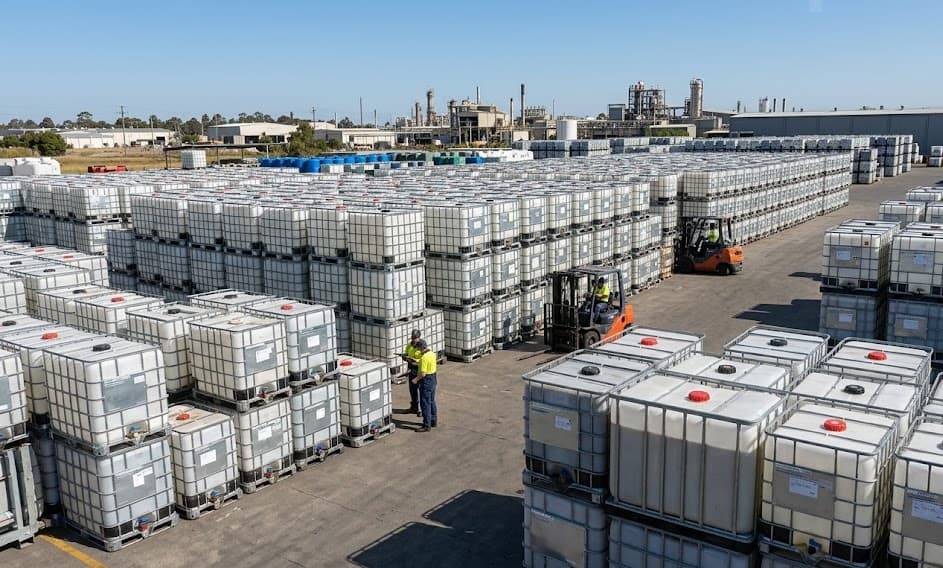
IBC Tote Cleaning & Reconditioning
Our multi-stage cleaning process transforms used IBC totes into like-new containers that meet food-grade, pharmaceutical, and industrial standards.
Get a Free Quote
The Process
10-Step Cleaning Process
Every IBC tote that passes through our cleaning line follows a rigorous, documented process designed to deliver consistent, verifiable results. No shortcuts, no skipped steps. Each stage is monitored, timed, and recorded for full traceability.
Initial Inspection & Classification
Every tote is visually and structurally inspected before cleaning begins. We check for cracks, warping, valve integrity, cage alignment, and pallet condition. Containers with irreparable damage are diverted to our recycling line rather than wasting cleaning resources. Each tote is classified by contamination level � light, moderate, or heavy � which determines the specific cleaning protocol and chemical agents used throughout the remaining steps.
Residue Drain & Content Capture
Remaining contents are drained and captured for proper disposal or recovery. Liquid residues are pumped into DOT-approved holding tanks segregated by chemical family. Solid or semi-solid residues are scraped and collected in labeled waste containers. All captured materials are documented by type, estimated volume, and hazard classification. This step ensures that no uncontrolled discharge enters our wastewater system or the environment.
High-Volume Pre-Rinse
The interior receives a high-volume pre-rinse using heated water at 120-140 degrees Fahrenheit to flush loose residues, sediment, and debris. Rotating spray heads deliver water at 40 gallons per minute, reaching all interior surfaces including the corners, base seams, and valve port area. Rinse water is collected in a closed-loop system and routed to our on-site wastewater treatment plant for processing before discharge.
Chemical Wash Cycle
Based on the contamination classification from Step 1, the appropriate cleaning agent is circulated through the tote at controlled concentration and temperature. We use alkaline detergents for organic residues (oils, syrups, food products), acid-based cleaners for mineral scale and inorganic deposits, and solvent-based agents for stubborn chemical films. All cleaning agents are FDA-approved for indirect food contact and are biodegradable to minimize environmental impact. Contact time, temperature, and concentration are monitored and recorded for every batch.
Triple-Rinse Cycle
The tote passes through three consecutive rinse stages using progressively cleaner water. This EPA-recognized protocol ensures that residual contamination levels and cleaning agent concentrations drop to near-zero before the next phase. The first rinse uses recycled process water, the second uses filtered municipal water, and the third uses deionized or reverse-osmosis purified water. Each rinse cycle is documented with duration, temperature, and water quality readings.
High-Pressure Interior Wash
Industrial-grade pressure washers blast the interior at up to 3,000 PSI using heated water at 160-180 degrees Fahrenheit. Rotating nozzle heads on articulated arms reach every corner of the bottle, including the hard-to-access areas around the valve port, base seams, and shoulder transitions. This mechanical action removes any stubborn films, label adhesive residue, and scale buildup that survived the chemical wash and triple-rinse stages.
Steam Sanitization
For food-grade and pharmaceutical applications, we follow the pressure wash with a saturated steam treatment at 250-270 degrees Fahrenheit for a minimum of 15 minutes. Steam penetrates surface micro-textures that liquid cleaning cannot reach, killing bacteria, mold spores, yeast, and other biological contaminants without introducing chemical residues into the container. Steam temperature and duration are recorded on every tote for certification purposes.
Exterior Cleaning & Cage Restoration
The steel cage is power-washed at 2,000 PSI to remove dirt, grease, and road grime. Surface rust is treated with a phosphoric acid solution that converts iron oxide to a stable iron phosphate layer, preventing further corrosion. Bent bars and crossmembers are straightened using hydraulic presses. Old labels, stickers, and paint markings are removed with solvent wipes and scrapers. Damaged valves, gaskets, and dust caps are replaced with new components. The result is a tote that looks and performs like it just left the factory.
Controlled Drying
Cleaned totes are moved to a dedicated drying bay where forced-air blowers circulate filtered, heated air at 100-120 degrees Fahrenheit through the interior for 30-60 minutes. The drying bay is enclosed and maintained at positive air pressure to prevent airborne contaminants from entering the tote during this vulnerable stage. Humidity sensors confirm that interior moisture levels drop below threshold before the tote proceeds to final inspection. No tote leaves the drying bay until it meets our moisture specification.
Final Quality Inspection & Certification
A dedicated quality inspector � not the same technician who performed the cleaning � conducts a 20-point inspection covering every component of the tote. The inspector verifies interior cleanliness, odor absence, valve function, cage integrity, pallet stability, and cosmetic appearance. Totes that fail any checkpoint are returned to the appropriate cleaning stage for rework. Only totes that pass all 20 points receive a dated, signed Cleaning Certificate and are cleared for inventory or shipment.
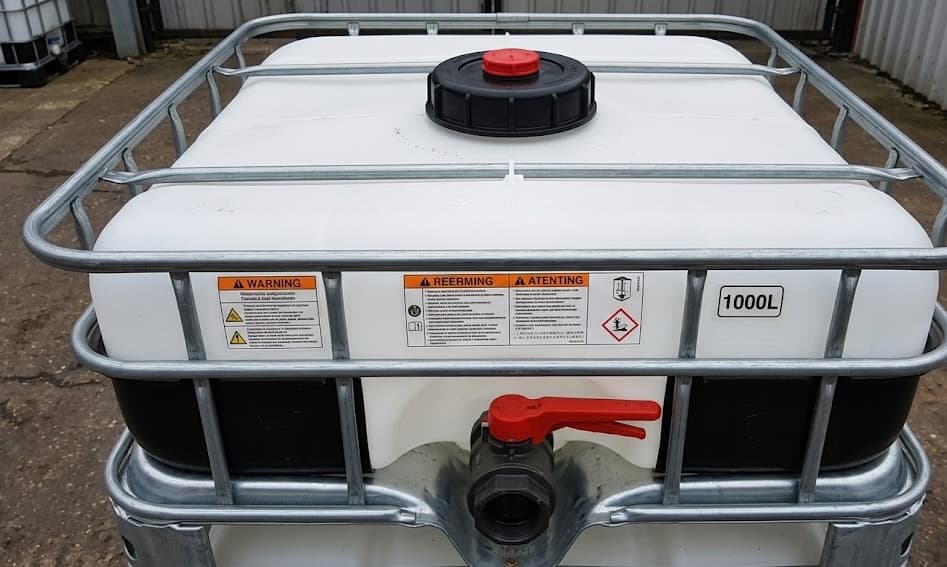
Precision at Every Detail
Caps, valves, and gaskets are inspected and replaced as part of every reconditioning job.
Chemistry
Cleaning Agents & Protocols
Different residues demand different chemistry. We maintain a library of cleaning agents matched to specific contamination types, each with documented temperature, contact time, and concentration parameters.
| Agent | Applications | Temp | Contact Time | FDA |
|---|---|---|---|---|
| Alkaline Detergent (pH 11-13) | Organic residues � cooking oils, syrups, juices, dairy, soaps, latex | 130-150�F | 15-30 minutes | Yes � 21 CFR 178.1010 compliant |
| Acid Cleaner (pH 1-3) | Mineral scale, rust stains, inorganic salt deposits, hard water buildup | 110-130�F | 10-20 minutes | Yes � food-grade formulations available |
| Solvent-Based Cleaner | Adhesive residue, petroleum-based films, ink, resin, and wax coatings | Ambient to 100�F | 20-45 minutes | Case dependent � non-food-grade totes only unless FDA-listed solvent |
| Enzymatic Cleaner | Protein-based residues, starch films, biological matter, fermentation byproducts | 90-110�F (enzyme-optimal range) | 30-60 minutes | Yes � GRAS-listed enzyme formulations |
| Chlorinated Sanitizer | Post-wash sanitization for food-grade totes; microbial kill step | 65-75�F | 2-5 minutes | Yes � 21 CFR 178.1010 compliant at specified concentrations |
| Peracetic Acid (PAA) | No-rinse final sanitizer for organic and food processing applications | 60-80�F | 1-3 minutes | Yes � FDA/USDA approved, no rinse required at approved concentration |
Compliance
FDA Food-Grade Compliance
Food and beverage manufacturers require containers that meet strict FDA 21 CFR standards for indirect food contact. Our cleaning process is engineered to achieve those standards consistently, batch after batch.
We use only FDA-approved cleaning agents, food-safe rinse water, and steam sanitization at temperatures that exceed pathogen kill thresholds. Every food-grade tote undergoes independent lab testing before certification, and all cleaning records are retained for a minimum of three years for audit purposes.
If your application falls under USDA, kosher, or organic certification programs, we can customize the cleaning protocol and provide the documentation your certifier requires. Our team has experience working with OU Kosher, USDA Organic, and SQF-certified operations.
Every food-grade cleaning certificate includes the cleaning date, the technician who performed the work, the chemical agents used (with Safety Data Sheets available on request), the steam temperature and duration, and the lab test results. This documentation package is designed to satisfy FDA inspectors, third-party auditors, and your own quality assurance team.
21 CFR Compliant
Steam Temperature
PSI Pressure Wash
Record Retention
Inspection Checklist
Swab Testing
Quality Assurance
20-Point Inspection Checklist
Every reconditioned tote must pass all 20 inspection points before receiving a cleaning certificate. A dedicated quality inspector � not the cleaning technician � performs this final verification.
Interior Bottle
- ✓No visible residue under inspection light
- ✓No staining, cloudiness, or discoloration
- ✓No odor detectable by trained inspector
- ✓No cracks, scratches deeper than 0.5mm, or stress marks
- ✓Smooth interior surface with no pitting or etching
Valve & Fittings
- ✓Valve opens and closes with smooth, consistent action
- ✓Gasket is new or certified leak-free under 5 PSI test
- ✓Threads are clean with no cross-threading or corrosion
- ✓Dust cap is present and properly seated
- ✓No drips or weeping at valve-to-bottle junction
Steel Cage
- ✓All bars and crossmembers are straight within 5mm tolerance
- ✓No structural rust � surface patina acceptable
- ✓All weld points are intact with no separation
- ✓Corner protectors are present and undamaged
- ✓Labels and markings fully removed
Pallet & Base
- ✓No cracked or broken runners
- ✓Fork channels are clear and undamaged
- ✓Pallet sits level on flat surface � no rocking
- ✓Drain plug (if applicable) is present and functional
- ✓Stacking lugs engage properly with unit above
Testing
Post-Cleaning Quality Tests
Cleaning is only half the job. Verification is what separates professional reconditioning from a rinse and hope. Every tote must pass these checks before it ships.
Visual Clarity Test
The interior bottle is inspected under a 500-lumen LED inspection light for staining, cloudiness, residue films, or embedded particles. Food-grade totes must pass a strict clarity standard where no discoloration is visible from any angle. Industrial totes allow minor cosmetic marks that do not indicate contamination.
Odor Assessment
Trained inspectors evaluate the interior for any lingering odors from previous contents. The tote is sealed for 30 minutes at room temperature to allow trace odors to concentrate, then opened and assessed by two independent inspectors. Totes that retain smell are re-processed through an additional chemical wash and steam cycle or downgraded to a lower grade.
Swab & Lab Analysis
For food and pharmaceutical clients, interior surface swabs are taken from five locations � center bottom, two opposing walls, shoulder area, and valve port � and sent to an independent lab for microbial culture, pH measurement, and chemical residue screening. Results are returned within 48-72 hours and included in the cleaning certificate package.
Valve Pressure Test
The discharge valve is tested under 5 PSI air pressure for 60 seconds to confirm a leak-free seal. A pressure gauge monitors for any drop, and the test is documented with pass/fail notation. Valves that fail are replaced with new OEM-specification components, retested, and cleared before the tote ships.
Structural Integrity Check
The cage is load-tested by stacking a weighted test pallet equivalent to a full tote (2,500 lbs) on top. The cage must support the load for 5 minutes without measurable deflection. The pallet is inspected for cracks, fork channel integrity, and level seating. Totes that fail structural testing are diverted to recycling.
Water Break Test
A thin film of water is sprayed on the interior bottle surface. On a properly cleaned HDPE surface, water sheets evenly without beading. Beading indicates residual contamination (oils, surfactants, or films) that require additional cleaning. This simple but effective test catches contamination that visual inspection alone may miss.
Environmental Responsibility
Wastewater Treatment
Cleaning IBC totes generates process water that must be treated before discharge. Our on-site treatment system ensures that every drop meets regulatory standards before it leaves our facility.
Collection
All rinse water, chemical wash effluent, and steam condensate is captured in floor drains and piped to our on-site treatment facility. No process water enters the municipal storm drain system.
Screening & Settling
Incoming wastewater passes through a bar screen to capture large solids, then enters a settling tank where suspended particles drop out under gravity. Settled solids are collected and disposed as non-hazardous industrial waste.
Chemical Treatment
pH is adjusted to neutral (6.5-8.5) using acid or caustic dosing. Flocculants are added to aggregate fine particles into settleable clumps. Dissolved metals are precipitated using chelation chemistry if present.
Filtration
Treated water passes through sand filters and activated carbon beds to remove remaining suspended solids, color, and organic compounds. The carbon beds also adsorb residual cleaning agents and chemical traces.
Monitoring & Discharge
Final effluent is tested for pH, total suspended solids (TSS), biochemical oxygen demand (BOD), and specific contaminants per our NPDES permit parameters. Only water that meets discharge limits is released. Out-of-spec batches are recirculated through the treatment system.
Reporting
We submit monthly Discharge Monitoring Reports (DMRs) to the Ohio EPA documenting all effluent testing results. Annual facility reports summarize total water usage, treatment volume, and compliance status. These records are available for client review upon request.
Timelines
Turnaround Times by Grade
Cleaning turnaround depends on the contamination level and the target grade. Here are our standard and rush timelines for each scenario.
| Grade | Standard | Rush | Notes |
|---|---|---|---|
| Light Contamination � Industrial Grade | 2-3 business days | 1 business day | Fastest turnaround � minimal chemical wash required |
| Moderate Contamination � Industrial Grade | 3-5 business days | 2 business days | Full chemical wash cycle required; may need extended soak |
| Heavy Contamination � Industrial Grade | 5-7 business days | 3 business days | Multiple wash cycles; possible solvent treatment step |
| Food-Grade Reconditioning | 5-7 business days | 3-4 business days | Includes independent lab testing (48-72 hour turnaround for results) |
| Pharmaceutical / Specialty | 7-10 business days | 4-5 business days | Custom protocol development may add lead time on first batch |
Pricing
Pricing by Contamination Level
Cleaning costs scale with the difficulty of the job. Here is how our pricing tiers work based on what your totes previously held and the target cleanliness standard.
Light Contamination
Base rateWater-based residues, food-grade liquids, mild chemicals that rinse clean with standard detergent. No extended soaking, no solvent treatment, and no special disposal required for captured residue.
Includes: Pre-rinse, alkaline wash, triple-rinse, pressure wash, drying, inspection, certificate
Moderate Contamination
Base rate + 25-50%Industrial chemicals, paints, adhesives, and concentrated solutions that require extended contact time with specialized cleaning agents. Captured residue may require manifested disposal.
Includes: Everything in Light, plus extended chemical soak, additional rinse cycles, residue disposal fees
Heavy Contamination
Base rate + 50-100%Petroleum products, hardened resins, multi-layer coatings, and materials that require solvent-based treatment or multiple sequential wash cycles to remove completely.
Includes: Everything in Moderate, plus solvent treatment, multiple wash cycles, extended drying, possible re-work
Food-Grade Certification
Base rate + 75-125%Full reconditioning protocol including steam sanitization and independent laboratory testing for microbial, chemical, and pH analysis. Required for any tote that will hold food, beverage, or pharmaceutical contents.
Includes: Full 10-step protocol, steam sanitization, lab swab testing, FDA-compliant cleaning certificate
Hazardous Residue
Custom quote requiredTotes that held RCRA-listed or characteristic hazardous waste. Requires specialized decontamination, manifested waste disposal, and additional documentation.
Includes: Hazmat decontamination, manifested disposal, EPA documentation, extended chain of custody
Results
Before & After
See the transformation our cleaning process delivers across every component of an IBC tote.
Interior Residue
Before
Coated with dried chemical or food residue, strong odor, discolored walls
After
Crystal-clear HDPE, no odor, no visible residue under inspection light
Valve & Fittings
Before
Corroded threads, stiff operation, worn gaskets, possible leaks
After
New or restored valve, smooth operation, fresh gasket, pressure-tested seal
Steel Cage
Before
Surface rust, bent bars, old labels and stickers, dented corners
After
Clean galvanized steel, straightened bars, all labels removed, no dents
Pallet Base
Before
Dirty, cracked runners, unstable stacking, forklift gouges
After
Washed surface, structurally verified, stable stacking, clean fork pockets
Documentation
Certification of Cleaning Document
Every cleaned tote receives a formal Certification of Cleaning document that serves as your proof of reconditioning quality. This is not a generic stamp � it is a detailed record that stands up to FDA inspectors, third-party auditors, and your own quality team.
What the Certificate Includes
- ✓Unique certificate tracking number
- ✓Date and time of cleaning completion
- ✓Tote serial number or intake ID
- ✓Previous contents (if known)
- ✓Cleaning protocol used (numbered steps)
- ✓Chemical agents applied with concentrations
- ✓Water temperature at each rinse stage
- ✓Steam temperature and duration (if applicable)
- ✓Lab test results (food-grade only)
- ✓Technician name and signature
- ✓Quality inspector name and signature
- ✓Target grade classification
- ✓Pass/fail status for each inspection point
- ✓Replacement parts installed (valves, gaskets)
- ✓Expiration date for food-grade certification
- ✓Record retention period notation
Certificates are issued in both digital (PDF) and printed format. Digital copies are stored in our system for a minimum of three years and can be retrieved by certificate number, tote ID, or customer account at any time. For bulk cleaning orders, we provide a batch summary certificate in addition to individual tote certificates.
Common Questions
Cleaning FAQ
What types of residues can you clean from IBC totes?
We clean totes that held food products, oils, soaps, many industrial chemicals, and other non-reactive materials. Extremely hazardous or incompatible residues are evaluated separately before acceptance.
Can you clean totes for food-grade reuse?
Yes. For qualifying containers, we offer food-grade cleaning protocols that include detailed wash steps, steam sanitization, inspection, and supporting cleaning documentation.
How long does IBC tote cleaning usually take?
Turnaround depends on contamination level and target grade. Standard industrial cleaning is usually faster, while food-grade and heavily contaminated totes take longer because they require additional processing and verification.
Do you replace valves, gaskets, or damaged components during cleaning?
Yes. If valves, gaskets, caps, or other components fail inspection, we replace them as part of the reconditioning process so the finished tote is functional and leak-free.
Do cleaned totes come with any documentation?
Yes. Cleaned totes can be issued with a cleaning certificate that records the processing path, inspection status, and key details needed for internal quality records or customer requirements.
Get Your Totes Cleaned
From a handful of totes to a full truckload, our cleaning team delivers consistent, certified results. Request a quote and we will have your containers restored in days, not weeks.
Request Cleaning Service