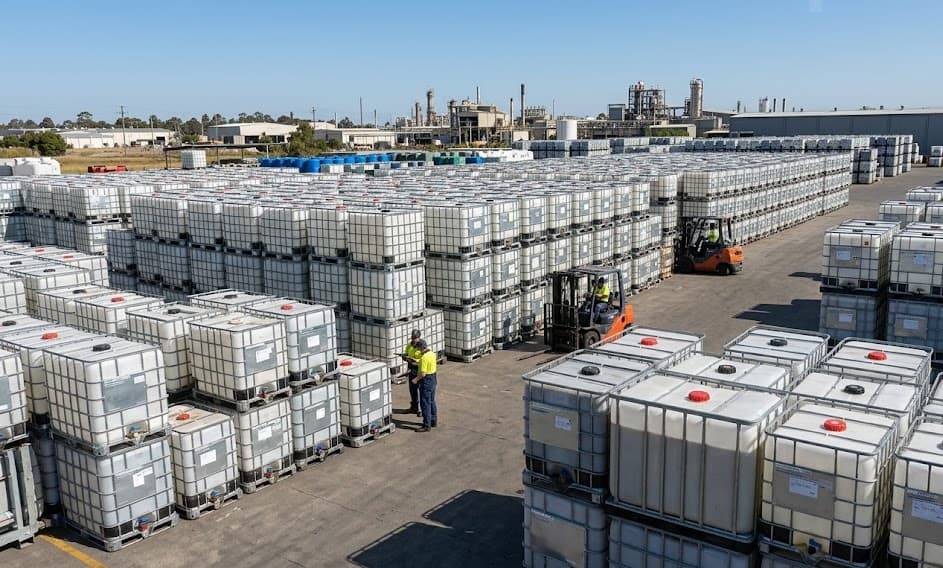
Reconditioned IBC Totes
Near-new performance at a fraction of the cost. Our eight-step reconditioning process restores used IBC totes to industry standards � with new valves, fresh gaskets, and a pressure-tested guarantee.
Get a Free Quote
What Is Reconditioning?
IBC reconditioning is a controlled industrial process that takes a used intermediate bulk container and restores it to a condition that meets or exceeds performance requirements for its next application. Unlike a simple rinse and resale, genuine reconditioning involves multi-stage cleaning, component replacement, structural repair, and rigorous testing.
At Cleveland IBC Recycling, our reconditioning line follows a documented eight-step protocol. Every container is tracked by serial number from intake through final inspection, and each unit ships with a reconditioning certificate that records the date of service, cleaning agents used, parts replaced, and test results.
The result is a container that performs like new � with a clean interior, new valves and gaskets, a structurally sound cage, and documented compliance � at 40�60% less than the cost of buying a brand-new tote. For the vast majority of industrial, agricultural, and food-grade applications, a reconditioned tote is the smartest purchase you can make.
Our 8-Step Reconditioning Process
Intake & Sorting
Every incoming tote is logged, photographed, and sorted by previous contents. Containers that held hazardous materials are separated for specialized handling. Each unit receives a unique tracking number that follows it through every subsequent step.
Residue Drain & Pre-Rinse
Remaining contents are drained and disposed of according to EPA regulations. A high-volume pre-rinse removes bulk residue from the inner bottle. This stage captures 90% or more of previous product residue before the main cleaning cycle begins.
Disassembly & Component Removal
The bottom discharge valve, top cap, and all gaskets are removed for individual inspection. The cage bolts are loosened to allow the bottle to be accessed and cleaned from all angles. Worn or damaged components are set aside for replacement.
Triple-Rinse Cleaning
The bottle goes through three sequential rinse cycles � hot water at 160�F to dissolve residue, alkaline detergent to break down organic compounds and oils, and a final sanitizing rinse with a food-safe antimicrobial agent. Each rinse cycle is timed and temperature-controlled.
Cage Repair & Treatment
The steel cage is straightened on a hydraulic jig if needed. Dents are pressed out, and bent tubes are realigned. Any rust is wire-brushed and treated with a zinc-rich cold-galvanizing compound to restore corrosion protection. Weld joints are re-inspected after straightening.
Component Replacement
Worn or damaged valves, gaskets, cap seals, and cage bolts are replaced with new OEM-spec parts. We use only first-quality replacement components � polypropylene or stainless steel valves, EPDM or PTFE gaskets, and food-grade cap seals as required by the application.
Pressure Testing
Each reassembled tote is filled with water and pressurized to 2.5 PSI (above working pressure) for a minimum of 30 minutes. Technicians check for micro-cracks, pinhole leaks, valve drip, and cap-seal integrity. Any container that fails is rejected from the reconditioning line.
Final Inspection & Certification
A senior technician performs a final visual and functional check covering 20 inspection points. Approved totes receive a dated reconditioning certificate, an inspection sticker, and a unique recertification number. The certificate records cleaning agents used, parts replaced, test pressure, and pass/fail results.
Quality Standards Met
Depending on the application, our reconditioned totes can meet the following regulatory and industry standards. Each standard has specific requirements that our reconditioning process is designed to satisfy.
| Standard | Scope | Details |
|---|---|---|
| UN/DOT UN31HA1 | Transportation of regulated liquids | Qualifying totes retain or receive UN31HA1/Y or UN31HA1/X markings for legal transport of hazardous and non-hazardous liquids. Rating depends on the original container and reconditioning results. |
| FDA 21 CFR 177.1520 | Food-contact materials | HDPE bottles used in food-grade reconditioning comply with FDA regulations for polyolefin containers in contact with food. Cleaning agents are FDA-approved for food-contact surface sanitation. |
| Kosher Certification | Food industry compliance | Available upon request. Our cleaning protocols can be verified by a kosher certification agency to meet the requirements for containers used in kosher food production and storage. |
| SQF / GMP Compatible | Food safety programs | Our reconditioning documentation � including cleaning logs, agent concentrations, rinse temperatures, and test results � supports SQF and GMP audit requirements for food-safety management programs. |
| OSHA 29 CFR 1910.106 | Flammable liquid storage | Reconditioned totes used for flammable liquids meet OSHA requirements for container integrity, proper labeling, and grounding/bonding provisions when fitted with appropriate hardware. |
| EPA 40 CFR 264/265 | Hazardous waste storage | When properly labeled and used within their UN rating, reconditioned IBC totes meet EPA requirements for temporary storage and transport of hazardous waste streams. |
Before & After Reconditioning
Reconditioning transforms a used tote into a container that performs like new. Here is a detailed look at what changes during the process.
| Attribute | Before | After |
|---|---|---|
| Bottle Appearance | Stained, discolored, or opaque from previous contents | Clear or lightly tinted � residue and staining removed by multi-stage cleaning |
| Interior Cleanliness | Residue film, dried product deposits, potential odor | Sanitized to food-grade or industrial standards � no detectable residue or odor |
| Valve Condition | Stiff operation, potential dripping, worn gasket | Brand-new valve with fresh gasket � smooth operation and positive shut-off |
| Cap & Seal | Compressed gasket, potential cross-threading from repeated use | New gasket installed, cap threads cleaned and verified for proper engagement |
| Cage Condition | Dents, bends, label residue, surface rust | Straightened, de-rusted, and treated with cold-galvanizing compound |
| Pallet | Fork-tine wear, minor bends, accumulated grime | Cleaned, inspected, and verified for safe stacking and forklift handling |
| Labeling | Old shipping labels, hazmat diamonds, handwritten markings | All previous labels removed. Fresh reconditioning certificate and inspection sticker applied |
| Certification | Original certification may be expired or invalid | New reconditioning certificate with date, serial number, and test results |
FDA Compliance Details
Food-grade reconditioning is our most rigorous cleaning tier. Here is exactly what it involves, how it meets federal requirements, and what documentation you receive.
HDPE Material Compliance
The HDPE bottle material in our reconditioned totes complies with FDA 21 CFR 177.1520 for olefin polymers intended for food contact. This regulation covers containers used to store, transport, and dispense food-grade liquids.
Cleaning Agent Approval
All detergents and sanitizers used in our food-grade reconditioning line are FDA-approved for food-contact surfaces under 21 CFR 178.1010. We maintain Safety Data Sheets (SDS) and Certificates of Analysis (COA) for every cleaning agent in our inventory.
Rinse Verification
After the final sanitizing rinse, we test the rinse water for residual detergent using a conductivity meter. The rinse water must test below 10 microsiemens/cm � close to the conductivity of deionized water � before the tote passes cleaning verification.
Documentation for Auditors
Every food-grade reconditioned tote ships with a cleaning certificate that includes the date and time of each rinse cycle, cleaning agent names and concentrations, rinse-water test results, and the technician ID. This documentation is designed to satisfy FDA, SQF, and GMP audit requirements.
Liner Recommendations
For the highest level of food-safety assurance, we recommend pairing a reconditioned tote with a single-use LDPE or aseptic liner. The liner creates an additional barrier between the product and the container wall, eliminating any concern about trace residue from previous contents.
When to Choose Reconditioned vs. New
For the majority of applications, a reconditioned tote delivers equivalent performance to a new container at a significantly lower cost. Here is a detailed comparison to help you decide.
| Feature | Reconditioned | New |
|---|---|---|
| Purchase Cost | 40�60% less than new | Full retail price |
| Cleanliness | Triple-rinsed and sanitized | Factory-clean, never used |
| Valve & Gaskets | Brand-new replacements | Brand-new from factory |
| Structural Integrity | Pressure-tested and verified | Manufacturer guaranteed |
| UN/DOT Certification | Available on qualifying units | Standard on rated models |
| Environmental Impact | Significantly lower footprint | Full virgin-material footprint |
| Lead Time | Typically in stock | May require 2�4 week order |
| Cosmetic Condition | Good � minor wear possible | Pristine |
| Warranty | 90-day functional warranty | Full manufacturer warranty (1�2 years) |
| FDA Food-Grade | Available � FDA-approved cleaning | Standard on compliant models |
| Traceability | Reconditioning certificate included | Manufacturer certificate of conformance |
When New Is the Right Choice
In certain situations, only a brand-new tote will satisfy your requirements. Choose new when:
- Regulations mandate a first-use, virgin container (common in pharmaceuticals and certain food applications)
- Your product is extremely sensitive to trace contamination (ultrapure water, electronic-grade solvents)
- The IBC ships directly to your end customer as part of your product packaging
- Your quality management system requires manufacturer certificates of conformance rather than reconditioning certificates
- You need a non-standard configuration (unusual size, specialized valve, custom color) that is not available in reconditioned inventory
Lifespan Expectations
A properly reconditioned IBC tote has significant service life remaining. How long it lasts depends on your usage conditions, stored contents, and storage environment.
| Usage Scenario | Expected Life | Notes |
|---|---|---|
| Indoor storage of non-corrosive liquids | 8�12 years | Minimal UV exposure and gentle handling maximize the lifespan of both the HDPE bottle and the steel cage. |
| Covered outdoor storage | 5�8 years | Shade structures or tarps protect the bottle from UV degradation. The cage may require periodic rust treatment in humid climates. |
| Uncovered outdoor storage | 3�5 years | Direct sunlight accelerates HDPE embrittlement. The bottle may become cloudy and develop micro-cracks after several years of continuous UV exposure. |
| Frequent filling and transport | 4�6 years | Repeated forklift handling, filling pressure, and transport vibration stress the cage, pallet, and valve. Periodic valve and gasket replacement extends functional life. |
| Aggressive chemical storage | 2�4 years | Strong oxidizers, concentrated acids, and aromatic solvents degrade HDPE faster than neutral or mild chemicals. Check compatibility before use. |
Warranty Details
Every reconditioned IBC tote from Cleveland IBC Recycling comes with a warranty that covers functional performance and workmanship. Here is exactly what is covered.
Leak-Free Guarantee
90 daysIf a reconditioned tote develops a leak through the bottle, valve, or cap gasket within 90 days of purchase, we will replace the unit or refund your purchase at our expense.
Valve & Gasket Warranty
90 daysNew valves and gaskets installed during reconditioning are warranted against manufacturing defects for 90 days. This covers cracking, seal failure, and handle breakage under normal use.
Cage Structural Integrity
90 daysIf the repaired cage develops new deformation or weld failure under normal two-high stacking loads within 90 days, we will replace the tote.
Reconditioning Certificate Accuracy
IndefiniteThe information on the reconditioning certificate � cleaning agents, test results, and parts replaced � is warranted to be accurate and complete for the life of the certificate.
Warranty Exclusions
The warranty does not cover damage resulting from:
- Misuse, overloading beyond rated capacity, or improper stacking (more than two high when full)
- Storage of chemicals incompatible with HDPE, polypropylene valves, or EPDM gaskets
- Physical damage from forklift impact, drops, or vehicle accidents after delivery
- UV degradation from prolonged uncovered outdoor exposure (use a UV cover or shade structure)
- Modifications or repairs performed by anyone other than Cleveland IBC Recycling
Industry Applications
Food & Beverage
Store and transport edible oils, syrups, vinegar, juice concentrates, and food-grade alcohols. Our food-grade reconditioning protocol eliminates cross-contamination risk. Pair with an aseptic liner for maximum safety on sensitive products.
Chemical Manufacturing
Transfer non-hazardous and certain hazardous chemicals with UN-rated reconditioned totes. Cost-effective replacement for worn containers in chemical plants. Stainless steel valve upgrades available for aggressive chemicals.
Pharmaceutical
Water-for-injection storage, cleaning solution transport, and waste liquid containment. Clean-room compatible when used with appropriate liners. Full documentation supports FDA and cGMP audit compliance.
Agriculture
Fertilizer concentrates, pesticide dilutions, and bulk water for irrigation. Reconditioned totes handle the demanding conditions of field use while providing a cleaner starting point than used totes.
Automotive & Metalworking
Coolants, cutting fluids, degreasers, and parts-washing solutions. A reconditioned tote keeps your shop floor organized at lower cost. The triple-rinse process removes previous fluid residue that could contaminate sensitive metalworking formulations.
Cosmetics & Personal Care
Bulk shampoo bases, lotions, soaps, and fragrance compounds. Food-grade cleaned totes ensure product purity for cosmetics formulators. Documentation supports GMP requirements common in the personal care industry.
Printing & Coatings
Water-based inks, coatings, and pigment dispersions. Reconditioned totes provide a clean container that prevents color cross-contamination between batches � a critical requirement for print-shop operations.
Water Treatment
Store and dispense treatment chemicals including chlorine solutions, pH adjusters, and coagulants. UN-rated reconditioned totes meet the containment requirements for municipal and industrial water treatment facilities.
Brewing & Distilling
Craft breweries and distilleries use reconditioned food-grade totes for water storage, ingredient transport, and waste stream management. The cost savings over new containers fund more important investments in production equipment.
The Smart Middle Ground
Reconditioned IBC totes deliver the performance you need without the cost of buying new or the uncertainty of buying used. Request a quote and we will recommend the best option for your specific application and volume.