IBC Tote Size Guide
Everything you need to know about IBC tote dimensions, weights, valve configurations, and material options � from 110 gallon to 550 gallon capacities.
Get a Free Quote
Understanding IBC Sizes
Choosing the Right Size IBC Tote
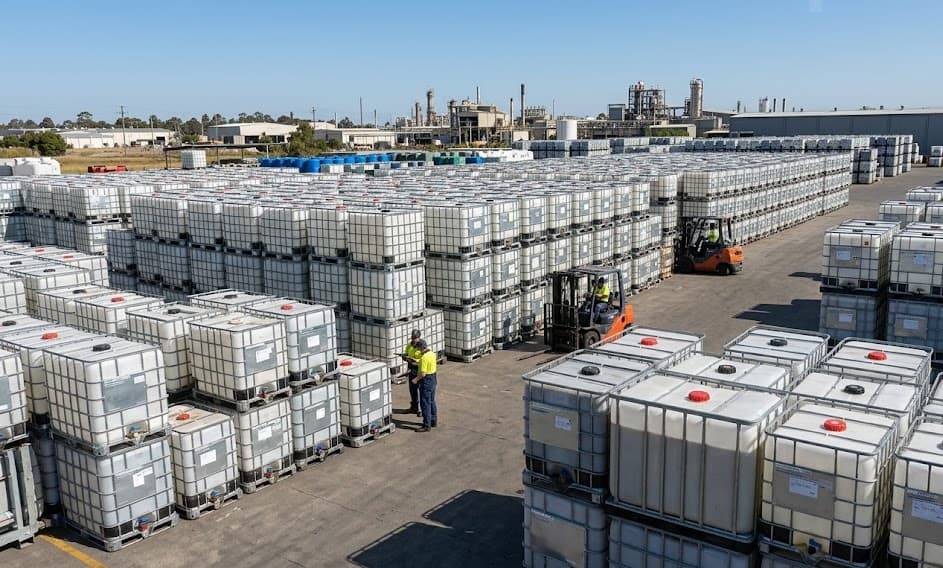
Intermediate Bulk Containers (IBCs) come in several standardized sizes designed to optimize storage density, shipping efficiency, and handling ease. The most common size by far is the 275-gallon (1,041-liter) tote, which sits on a standard 48" × 40" pallet and fits perfectly inside standard shipping containers and truck trailers.
Selecting the correct IBC size involves balancing your volume requirements against available floor space, forklift capacity, weight restrictions, and regulatory considerations. A 275-gallon tote filled with water weighs approximately 2,413 lbs � well within most standard forklift capacities, but heavy enough that floor loading matters in multi-story facilities.
Below, we break down every specification you need to make an informed decision. Whether you're sourcing totes for a Cleveland-area manufacturing operation or a nationwide supply chain, this guide covers the dimensions, weights, valve options, and material choices that matter.
IBC Tote Dimensions & Weights
Standard dimensions for composite (HDPE + steel cage) IBC totes. Measurements may vary slightly by manufacturer.
| Capacity | L × W × H (in) | L × W × H (cm) | Empty Weight | Full Weight (Water) | Pallet Compatibility |
|---|---|---|---|---|---|
| 110 gal / 416 L | 32" × 30" × 36" | 81 × 76 × 91 cm | 75 lbs / 34 kg | 990 lbs / 449 kg | Non-standard (smaller footprint) |
| 275 gal / 1041 LMost Common | 48" × 40" × 46" | 122 × 102 × 117 cm | 118 lbs / 54 kg | 2413 lbs / 1095 kg | Standard 48�40 pallet |
| 330 gal / 1249 L | 48" × 40" × 53" | 122 × 102 × 135 cm | 130 lbs / 59 kg | 2882 lbs / 1308 kg | Standard 48�40 pallet |
| 550 gal / 2082 L | 48" × 48" × 62" | 122 × 122 × 157 cm | 195 lbs / 88 kg | 4785 lbs / 2171 kg | Double-wide 48�48 pallet |
Important Notes on Dimensions
- ▸Dimensions include the cage and pallet. The HDPE bottle inside is slightly smaller than the listed external measurements.
- ▸Height measurements include the pallet base (typically 5.5" to 6" for wood pallets, 6" for composite pallets).
- ▸Full weights are calculated using water (8.34 lbs/gal). Denser liquids like chemicals or syrups will weigh significantly more.
- ▸Manufacturers like Schuetz (Mauser), Greif, and Snyder may have slight dimensional variations (±0.5" typical).
Why the 275-Gallon Tote Is the Industry Standard
The 275-gallon IBC tote dominates the market for good reason. Its 48" × 40" footprint matches the standard GMA pallet used throughout North American logistics. This means it integrates seamlessly with existing warehouse racking, truck trailers, and shipping containers without wasted space.
A standard 53-foot dry van trailer can fit 20 to 24 empty 275-gallon IBCs (nested or stacked), or up to 20 full totes in a double-stacked configuration � assuming load weight stays under the 44,000-lb trailer limit. A 20-foot intermodal container holds 4 totes on a single level or 8 when stacked two-high.
From a handling perspective, the 275-gallon size strikes the ideal balance. At roughly 2,400 lbs when full of water, it stays within the capacity of standard 5,000-lb forklifts while still delivering meaningful volume. Compare that to a 55-gallon drum at ~460 lbs full � you'd need five drums to match one IBC, taking up far more floor space and requiring five separate handling operations.
Volume ratio vs. 55-gallon drums � one IBC replaces five drums
Standard GMA pallet footprint for universal logistics compatibility
Full weight with water � within standard forklift capacity
Pallet Compatibility
IBC tote pallets come in several types, and the pallet is considered an integral structural component � not just a shipping convenience. The pallet bears the full weight of the filled container and provides the base for forklift entry and stacking stability.
Wood Pallet
- Dimensions: 48" × 40" (standard GMA)
- Height: 5.5" to 6"
- Weight capacity: 2,500+ lbs
- Entry: 4-way fork entry
- Pros: Lowest cost, easy to replace, repairable
- Cons: Can rot, splinter, or harbor pests; ISPM-15 treatment required for export
Composite / Plastic Pallet
- Dimensions: 48" × 40" (standard)
- Height: ~6"
- Weight capacity: 2,500+ lbs
- Entry: 4-way fork entry
- Pros: Washable, pest-free, longer lifespan, no ISPM-15 needed
- Cons: Higher initial cost, not repairable � replacement only
Steel Pallet
- Dimensions: 48" × 40" or 48" × 48"
- Height: ~6"
- Weight capacity: 5,000+ lbs
- Entry: 2-way or 4-way fork entry
- Pros: Extremely durable, fire-resistant, high load rating
- Cons: Heaviest option, highest cost, can rust without coating
Pallet Replacement Tips
- When to replace: Cracked runners, broken boards, excessive rot, or visible structural compromise
- Rebottling: The HDPE bottle can be transferred to a new cage/pallet assembly during reconditioning
- Matching: Always use manufacturer-recommended pallet types to maintain UN certification
- Cost: Pallet replacement typically costs $15�$40 for wood, $40�$80 for composite
Valve Types & Discharge Options
The bottom discharge valve is one of the most important components of an IBC tote. The right valve type ensures safe, efficient dispensing while preventing leaks and contamination. All standard IBC valves use a 2" (DN50) connection, but the internal mechanism varies.
2? Butterfly Valve
The industry standard for composite IBC totes. Quarter-turn operation allows rapid flow control. Commonly found on 275 and 330 gallon totes used for non-viscous liquids like water, chemicals, and juices.
Thread Type
NPS 2? female thread
Flow Characteristics
High flow rate � ideal for gravity discharge
Best For
Water, thin chemicals, agricultural liquids
2? Ball Valve
Provides a tighter seal than butterfly valves and is better suited for viscous materials or applications where drip-free shutoff is critical. Ball valves offer full-bore flow with minimal pressure drop.
Thread Type
NPS 2? female thread
Flow Characteristics
Full bore � minimal restriction
Best For
Syrups, oils, viscous chemicals, food products
Cam Lock Adapter
Quick-connect cam lock fittings allow rapid hose connection without threading. Available in various materials including polypropylene, stainless steel, and aluminum. Often used in industrial transfer operations.
Thread Type
2? cam lock Type A, B, C, or D
Flow Characteristics
Depends on adapter configuration
Best For
Frequent connect/disconnect, industrial transfer
Top Opening & Lid Sizes
6" (150mm) Screw Cap
The standard fill opening on most composite IBC totes. The 6-inch screw cap provides adequate access for filling via hose, pump, or gravity. The cap typically includes a 2" vented or non-vented plug for pressure equalization during dispensing. Gasket material is usually EPDM or PE foam.
150mm Butterfly Lid
Found on some European-standard IBCs, the 150mm butterfly lid flips open rather than threading. This design allows faster filling and easier cleaning access. Common on totes used in food and beverage applications where frequent cleaning between batches is required.
Material Comparison
IBC totes are manufactured from different materials to serve different industries and applications. Here's how they compare across the metrics that matter.
HDPE Bottle + Galvanized Steel Cage
Weight (275 gal)
~118 lbs (275 gal)
Durability
Good � cage protects bottle from impact
Chemical Resistance
Excellent � HDPE resists most acids, bases, and solvents
Temperature Range
-40�F to 140�F (-40�C to 60�C)
Food Safe
Yes � FDA-compliant when new
Cost Level
$$ � Most cost-effective option
Expected Lifespan
3�5 years (bottle), 10+ years (cage)
Best For
General purpose, agriculture, chemicals, food
Stainless Steel (304 or 316)
Weight (275 gal)
~250 lbs (275 gal)
Durability
Excellent � resistant to dents and punctures
Chemical Resistance
Very good � 316 SS superior for corrosive environments
Temperature Range
-40�F to 400�F (-40�C to 204�C)
Food Safe
Yes � pharmaceutical and food grade
Cost Level
$$$$ � Premium option
Expected Lifespan
20+ years with proper maintenance
Best For
Pharmaceutical, high-temp, corrosive chemicals, sanitary applications
Carbon Steel
Weight (275 gal)
~275 lbs (275 gal)
Durability
Very good � heavy-duty construction
Chemical Resistance
Moderate � requires interior lining for corrosive materials
Temperature Range
-40�F to 300�F (-40�C to 149�C)
Food Safe
Only with approved interior lining
Cost Level
$$$ � Mid-range
Expected Lifespan
15+ years with coating maintenance
Best For
Petroleum products, non-corrosive chemicals, industrial storage
Stacking Specifications
Proper stacking is critical for safety and for maintaining tote integrity. IBC totes are designed to be stacked when full, but only under specific conditions. Incorrect stacking can lead to cage deformation, bottle failure, valve damage, or catastrophic collapse.
Full Totes (Composite)
- Maximum stack: 2 high when filled to rated capacity
- Surface: Level, solid floor only � never on uneven ground
- Alignment: Totes must be directly centered above each other with corners aligned
- Weight: Top tote weight must not exceed the bottom tote's rated stacking load (typically 6,600 lbs / 3,000 kg for standard composite IBCs)
- Condition: Do not stack if cage is deformed, bent, or has damaged corner posts
Empty Totes
- Maximum stack: 3�4 high depending on manufacturer specifications
- Wind load: Secure against wind when stored outdoors � empty totes can topple
- Nesting: Some manufacturers offer collapsible or foldable IBCs for more efficient empty storage
- Cap valve: Always close the discharge valve and install a dust cap before stacking to prevent contamination
- UV exposure: Prolonged outdoor storage degrades HDPE � cover or shade when possible
Safety Warning
Never stack IBC totes higher than the manufacturer's rated maximum. A fully loaded 275-gallon IBC weighs over one ton � a stacking failure can cause serious injury or death. Always inspect cage corner posts for bowing, cracking, or weld failures before stacking. If in doubt, store on a single level only. Refer to your specific manufacturer's stacking guidelines and applicable OSHA regulations for your facility.
How to Choose the Right IBC for Your Application
Selecting the right IBC tote isn't just about volume. Consider these factors to find the best match for your operation.
1. What Are You Storing?
Chemical compatibility is non-negotiable. HDPE handles most acids, bases, and common solvents well, but certain chemicals (strong oxidizers, aromatic solvents, fluorinated compounds) can degrade the plastic. Stainless steel is required for high-purity applications or aggressive chemicals. Always check the manufacturer's chemical compatibility chart for your specific substance.
2. What Volume Do You Need?
For most applications, the 275-gallon tote is the sweet spot. If you need less than 200 gallons per batch, the 110-gallon size avoids wasted headspace and reduces weight. If you need maximum volume per pallet position, the 330-gallon uses the same footprint as the 275 but is taller. The 550-gallon is best for bulk storage where floor space is limited and forklift capacity allows the extra weight.
3. Is It Food Grade?
If your application involves food, beverages, or potable water, you need an IBC with an FDA-compliant HDPE bottle that has never held non-food substances. Reconditioned totes can be food-grade if they were previously used only for food-grade materials and were properly cleaned. A new tote is the safest option for food-contact applications. Look for UN31HA1/Y marking and FDA 21 CFR compliance.
4. Will You Ship the IBC?
If the IBC will be transported on public roads with hazardous materials, it must carry current UN certification. Used and reconditioned IBCs can retain their UN rating within 5 years of manufacture (for composite types) if they pass inspection. Non-hazmat shipments have no UN requirement, but the tote should still be structurally sound.
5. What's Your Budget?
New composite IBCs typically run $200�$350. Reconditioned totes cost $100�$200. Used totes start at $50�$125 depending on grade and condition. Stainless steel IBCs range from $1,500�$4,000+ new. For many applications, a reconditioned IBC delivers 90% of new-tote performance at 50% of the cost.Contact us for current pricing.
6. Temperature and Environment
Standard HDPE IBCs are rated for -40°F to 140°F. If your product requires heating (like wax, coconut oil, or chocolate), you may need a heating blanket accessory rather than a different tote material. For sustained temperatures above 150°F, stainless steel is the correct choice. For outdoor storage in Cleveland's climate, ensure totes are UV-stabilized and protected from prolonged direct sunlight to prevent bottle degradation.
Need Help Choosing?
Our team has handled thousands of IBC totes across every industry. Tell us what you're storing and we'll recommend the right size, material, and grade for your application.