The Complete IBC Tank Guide
Your comprehensive reference for everything about Intermediate Bulk Containers � from construction and components to regulations, maintenance, and industry applications.
Get a Free Quote
In This Guide
What Is an IBC Tote?
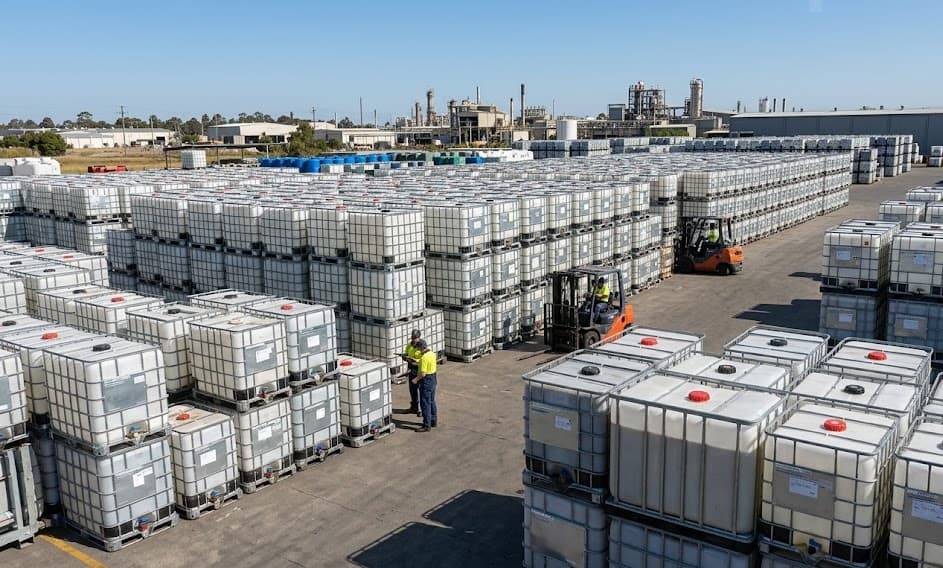
An Intermediate Bulk Container (IBC), commonly called an IBC tote, IBC tank, or simply a tote, is a reusable industrial container designed for the transport and storage of bulk liquid and granular substances. The "intermediate" in the name refers to its capacity � larger than a drum (55 gallons) but smaller than a tank truck or rail car (thousands of gallons).
The most common type is the composite IBC, which consists of a blow-molded HDPE (high-density polyethylene) inner bottle surrounded by a tubular galvanized steel cage, all mounted on an integrated pallet base. This design combines the chemical resistance of plastic with the structural protection and stackability of steel.
Standard capacities range from 110 gallons (416 liters) to 550 gallons (2,082 liters), with the 275-gallon (1,041-liter) size being the overwhelming industry standard. At this capacity, a single IBC replaces approximately five 55-gallon drums while occupying roughly the same floor space � making it dramatically more space-efficient and reducing handling labor by up to 80%.
IBCs are used across virtually every industry that handles liquids in bulk: food and beverage, chemical manufacturing, agriculture, pharmaceuticals, petroleum, cosmetics, cleaning products, and more. Their standardized dimensions allow them to integrate seamlessly with palletized logistics systems worldwide.
History & Development
The IBC as we know it today evolved through several decades of industrial packaging innovation. Before IBCs, the 55-gallon steel drum was the dominant bulk liquid container � a design essentially unchanged since the early 1900s. While reliable, drums were labor-intensive: filling, sealing, palletizing, and emptying five drums to move 275 gallons added significant cost and handling time.
The concept of an intermediate-sized container emerged in the 1970s when European manufacturers began developing larger, pallet-compatible containers that could be moved by forklift. The first metal IBCs � essentially large rectangular steel tanks on pallets � appeared in the late 1970s and early 1980s.
The breakthrough came in the mid-1980s when Schuetz (now Mauser Packaging Solutions) developed the composite IBC: a blow-molded HDPE bottle inside a welded tubular steel cage on a pallet base. This design was lighter than all-metal IBCs, offered excellent chemical resistance, and was far cheaper to manufacture. The composite IBC quickly became the global standard.
By the 1990s, the United Nations had established standardized testing and certification requirements (the UN performance marking system) for IBCs used to transport dangerous goods. Today, the composite IBC is manufactured by dozens of companies worldwide, with Mauser, Greif, Schuetz, and Snyder Industries among the largest producers. An estimated 20+ million new composite IBCs are manufactured annually worldwide.
The recycling and reconditioning industry developed alongside the IBC market. As millions of totes reached end-of-first-use each year, companies like Cleveland IBC Recycling emerged to collect, clean, repair, and redistribute used containers � creating a circular economy that reduces waste and provides cost-effective alternatives to new purchases.
Types of IBC Containers
While "IBC" usually brings the composite tote to mind, several distinct types exist, each suited to different applications and materials.
Composite IBC (HDPE + Steel Cage)
The most common type by far, accounting for over 80% of all IBCs in use globally. The inner bottle is blow-molded from virgin HDPE and the outer cage is welded from galvanized tubular steel. Available in 110, 275, 330, and 550-gallon capacities.
UN Designation
31HA1
Temperature
-40°F to 140°F
Typical Life
3�5 years (bottle)
Recyclable
Fully � bottle & cage
Stainless Steel IBC
Constructed entirely from 304 or 316 stainless steel, these IBCs are designed for demanding applications where hygiene, temperature resistance, or chemical compatibility exceeds what HDPE can offer. Commonly used in pharmaceutical manufacturing, food processing, and aggressive chemical storage. They feature tri-clamp sanitary fittings, CIP (clean-in-place) capability, and optional heating/cooling jackets.
UN Designation
31A (rigid)
Temperature
-40°F to 400°F+
Typical Life
20+ years
Cost
$1,500�$4,000+
Carbon Steel IBC
Heavy-duty steel containers with optional interior linings (epoxy, phenolic, or polyethylene) for chemical compatibility. Common for petroleum products, lubricants, and industrial solvents where the robustness of all-metal construction is needed but stainless steel's cost is not justified.
UN Designation
31A (rigid)
Temperature
-40°F to 300°F
Typical Life
15+ years
Cost
$600�$1,500
Flexible IBC (FIBC / Bulk Bag)
While technically a different category, Flexible Intermediate Bulk Containers (FIBCs) � commonly known as bulk bags or super sacks � are worth mentioning. These woven polypropylene bags hold dry granular materials like grain, sand, chemicals, and powders. They are not suitable for liquids (without an inner liner) and serve an entirely different market segment than rigid IBCs.
UN Designation
13H (flexible)
Capacity
500�4,400 lbs
Typical Life
1�5 uses
For Liquids?
No (dry goods only)
IBC Component Breakdown
A composite IBC tote consists of five main components, each playing a critical role in the container's performance, safety, and longevity. Understanding these components helps with purchasing decisions, maintenance, and troubleshooting.
The Bottle (Inner Container)
The HDPE bottle is the liquid-contact surface and the most critical component for product safety. Manufactured via blow molding from virgin high-density polyethylene resin, the bottle wall thickness typically ranges from 2mm to 4mm. HDPE offers excellent chemical resistance to most acids, bases, and common industrial chemicals, though it can be attacked by strong oxidizers and certain solvents. The bottle is the component with the shortest lifespan (3�5 years for UN certification) because UV exposure and chemical contact gradually degrade the polymer structure. During reconditioning, the bottle can be replaced while reusing the cage and pallet � a process called "rebottling" that significantly reduces cost and environmental impact.
The Cage (Outer Frame)
The galvanized steel cage provides structural rigidity, impact protection, and stackability. It consists of welded tubular steel members forming a rectangular frame around the bottle. The cage features four corner posts that bear stacking loads (rated at 6,600 lbs / 3,000 kg for standard models), horizontal cross-members for lateral stability, and a top frame that supports stacked weight. Galvanization protects against corrosion, giving the cage a lifespan of 10+ years. Cages can be straightened, rewelded, and re-galvanized during reconditioning. A damaged cage that cannot be repaired is recycled as scrap steel.
The Pallet (Base)
The pallet is an integral part of the IBC � not a separate component like a shipping pallet. It's permanently attached to the cage and provides the base for forklift handling and stacking. Available in wood, composite (HDPE/PP), and steel. The standard footprint is 48" × 40" (GMA standard) for 275 and 330-gallon models. Four-way fork entry is standard, allowing approach from any direction. Wood pallets are cheapest but susceptible to rot and pest infestation; composite pallets cost more but last longer and don't require ISPM-15 heat treatment for international shipping. See our Size Guide for detailed pallet specifications.
The Valve (Discharge)
Located at the bottom front of the IBC, the discharge valve is the primary outlet for product dispensing. The standard connection is 2" NPS (National Pipe Straight) female thread on the bottle outlet, with a valve body that screws onto this thread. The two most common valve types are butterfly valves (quarter-turn, high flow, economical) and ball valves (full bore, tighter seal, better for viscous materials). Cam lock adapters can be added to either type for quick hose connections. Valves are consumable components � gaskets wear, handles break, and internal mechanisms can fail. Valve replacement during reconditioning is routine and costs $10�$30 per valve.
The Lid (Fill Opening)
The top fill opening is typically 6" (150mm) in diameter with a threaded screw cap. The cap often includes a smaller 2" vented or non-vented bung plug for pressure equalization during dispensing. Gasket materials include EPDM (general purpose), Viton (chemical resistant), and silicone (food grade). The lid area also includes a breather vent on some models to prevent vacuum lock during gravity discharge. Proper lid maintenance � ensuring gaskets are intact and threads are clean � is essential for preventing contamination and leakage during transport.
UN Ratings & Certifications
The United Nations performance marking system is the global standard for certifying that packaging is safe to transport dangerous goods. If you're shipping hazardous materials by road, rail, sea, or air, your IBC must carry valid UN certification. Here's how to read the markings.
Decoding the UN Marking: UN31HA1/Y/MM YY/USA/...
UN31HA1
- 31 � Rigid IBC for liquids
- H � Plastic (HDPE) inner container
- A � Rigid outer packaging (steel cage)
- 1 � Composite IBC with rigid inner plastic container
Performance Level
- X � Packing Groups I, II, III (highest hazard)
- Y � Packing Groups II and III (medium hazard)
- Z � Packing Group III only (lowest hazard)
Additional Marking Elements
- MM/YY � Month and year of manufacture
- Country code � Country where certification was granted (e.g., USA, D for Germany)
- Manufacturer code � Identifies the specific manufacturer
- Max gross mass � Maximum allowed weight when filled (e.g., 1500 kg)
- Stacking load � Maximum stacking weight in kg
- Hydrostatic test pressure � Pressure the IBC was tested at (in kPa)
Certification Lifespan
Composite IBCs (UN31HA1) have a 5-year service life from the date of manufacture for transporting dangerous goods. After 5 years, the IBC cannot be refilled with hazardous materials for transport � even if it appears to be in perfect condition. However, it can still be used for non-hazmat storage and transport indefinitely. Rebottled IBCs receive a new 5-year certification window from the date of rebottling, provided the reconditioning facility is UN-certified. Metal IBCs (31A) have a 2.5-year inspection interval and no fixed service life � they can be recertified indefinitely as long as they pass inspection.
Maintenance & Care Tips
Proper maintenance extends the usable life of an IBC tote and protects the quality of its contents. Whether you're managing a fleet of hundreds or just a few totes, these practices will help you get the most from your investment.
After Each Use
- ✓Drain completely � residual liquid accelerates degradation and can cause contamination
- ✓Rinse with appropriate solvent or water within 24 hours of emptying
- ✓Close the discharge valve and replace the dust cap to prevent debris entry
- ✓Replace the lid cap tightly to keep out rain, insects, and airborne contaminants
- ✓Label the tote with its previous contents for proper cleaning at reconditioning
Regular Inspections
- ✓Check cage for bent, cracked, or broken welds � especially corner posts and top frame
- ✓Inspect the bottle for cracks, bulging, discoloration, or UV degradation (chalky white appearance)
- ✓Test the discharge valve � it should open and close smoothly with no leaks
- ✓Verify lid gasket integrity � a hardened or cracked gasket will leak
- ✓Check pallet for cracked boards, split runners, or loose fasteners
Cleaning Best Practices
- ✓Use a pressure washer (1,500�3,000 PSI) with appropriate cleaning solution
- ✓For food-grade applications, use FDA-approved sanitizing agents
- ✓Triple-rinse protocol: detergent wash, fresh water rinse, sanitizer rinse
- ✓Allow full drying before refilling � trapped moisture breeds bacteria and mold
When to Retire a Tote
- ✗Bottle shows cracks, deep scoring, or wall thinning
- ✗UN certification has expired and hazmat transport is needed
- ✗Cage has multiple broken welds or severely bent corner posts
- ✗Persistent odor or staining that cannot be removed by professional cleaning
- ✗Bottle has swelled or deformed from chemical reaction � recycle it
Storage Best Practices
How you store IBC totes � both full and empty � directly impacts their lifespan, product integrity, and your facility's safety. Here are the key guidelines for IBC storage.
Indoor Storage
- Store on level, smooth concrete floors capable of supporting the load
- Maintain adequate aisle width for forklift access (minimum 12 feet for standard forklifts)
- Keep ambient temperature between 40°F and 100°F for HDPE totes
- Ensure adequate ventilation, especially when storing volatile materials
- Separate incompatible chemicals per SDS requirements � use secondary containment
- Install spill containment berms or pallets (required for hazardous materials)
- Keep fire suppression systems unobstructed and maintain clear access to exits
Outdoor Storage
- Protect from direct sunlight � UV degrades HDPE and shortens bottle life significantly
- Use tarps, shade structures, or UV-resistant covers
- Elevate off bare ground to prevent moisture damage to wood pallets
- Secure against wind � empty IBCs are light enough to topple or roll
- Prevent rainwater pooling on tote lids (leads to contamination if seals fail)
- In Cleveland's climate, protect from freeze/thaw cycles if water-based contents remain inside
- Ensure stormwater runoff is managed to prevent contamination of drains
Secondary Containment Requirements
EPA regulations under 40 CFR 264.175 require secondary containment for hazardous material storage. The containment system must hold at least 110% of the volume of the largest container or 10% of the total volume of all containers � whichever is greater. For a single 275-gallon IBC, this means containment capacity of at least 302.5 gallons. Options include concrete containment berms, polyethylene spill pallets (available in single and double IBC configurations), and steel containment platforms. Even for non-hazardous materials, secondary containment is a best practice that protects your facility and the environment from accidental spills.
Common Industry Applications
IBC totes serve an astonishing range of industries. Here's how different sectors use them in the Cleveland area and beyond.
Food & Beverage
Juice concentrates, liquid sweeteners, cooking oils, vinegar, wine, flavoring extracts, liquid eggs, and dairy products. Food-grade IBCs must be FDA-compliant and typically require single-use or professionally reconditioned totes with documented cleaning protocols.
Learn more →Chemical Manufacturing
Industrial solvents, cleaning agents, adhesives, coatings, resins, acids, bases, and specialty chemicals. Chemical IBCs must be compatible with their contents and carry appropriate UN ratings for transport. Dedicated totes (never cross-contaminated) are standard practice.
Learn more →Agriculture
Liquid fertilizers, pesticides, herbicides, water for irrigation, livestock supplements, and seed treatments. Agricultural operations often purchase used IBCs at lower cost for applications like water storage and non-food liquid handling. Totes are also repurposed as rainwater collection systems on farms.
Learn more →Pharmaceuticals
Purified water, API (Active Pharmaceutical Ingredient) solutions, excipients, and cleaning solutions. Pharmaceutical applications typically require stainless steel IBCs with full traceability, validated cleaning procedures, and GMP-compliant documentation.
Learn more →Manufacturing
Coolants, lubricants, hydraulic fluids, parts-washing solvents, paints, and coatings. Manufacturing facilities are among the largest consumers and generators of used IBCs. Many manufacturers have established IBC return programs with their suppliers to reduce packaging waste and cost.
Learn more →Petroleum & Energy
Motor oils, transmission fluids, antifreeze, diesel exhaust fluid (DEF), drilling muds, and produced water. The petroleum industry often requires IBCs with specific liner materials or all-steel construction to handle hydrocarbon products safely.
Safety Considerations
Working with IBC totes involves handling heavy loads, potentially hazardous materials, and equipment that can cause serious injury if misused. Follow these safety protocols to protect your team and your facility.
Forklift Handling
- • Only trained, certified forklift operators should move IBC totes
- • Verify forklift capacity before lifting � a full 275-gal IBC weighs ~2,400 lbs
- • Center the forks fully in the pallet openings before lifting
- • Never drive with a raised load � keep the IBC as low as possible during transport
- • Avoid sudden stops, starts, and turns that can shift the liquid load and tip the forklift
- • Never lift an IBC by the cage � always use the pallet fork pockets
Chemical Safety
- • Always review the Safety Data Sheet (SDS) before handling any IBC contents
- • Wear appropriate PPE: chemical-resistant gloves, safety glasses, and protective clothing
- • Never assume an "empty" IBC is safe � residual vapors can be flammable or toxic
- • Ground metal IBCs and dispensing equipment when handling flammable liquids to prevent static discharge
- • Ensure adequate ventilation when opening IBCs containing volatile substances
- • Have spill kits and emergency equipment readily accessible in IBC storage areas
Stacking Safety
- • Never exceed the manufacturer's rated stacking height (typically 2 high for full composite IBCs)
- • Inspect corner posts and cage before stacking � bent or damaged cages cannot safely bear stack loads
- • Stack only on level, solid surfaces � never on sloped or uneven ground
- • Ensure perfect alignment � offset stacking creates dangerous shear forces
- • Consider seismic risk in your region when designing IBC storage layouts
Static Electricity & Grounding
HDPE is non-conductive, which means static charges can accumulate on composite IBCs during filling and dispensing. When handling flammable liquids (flash point below 100°F), static discharge can ignite vapors. Always use grounding straps connected to the metal cage and ensure the dispensing equipment is properly bonded. Some operations require antistatic IBC liners or conductive HDPE bottles for flammable material handling. Consult NFPA 77 (Recommended Practice on Static Electricity) for specific guidance.
Regulations: DOT, FDA & EPA
Three primary regulatory frameworks govern IBC use in the United States. Understanding which regulations apply to your operation is essential for compliance and safety.
DOT (Department of Transportation)
The DOT regulates the transport of hazardous materials under 49 CFR Parts 171�180. Key requirements for IBC users include:
- • IBCs used to transport hazardous materials must carry valid UN performance markings
- • Composite IBCs have a maximum 5-year service life for hazmat transport from date of manufacture
- • Shippers must comply with marking, labeling, and placarding requirements
- • Drivers must hold a CDL with HazMat endorsement for certain quantities
- • Shipping papers must accurately describe contents, UN number, packing group, and quantity
- • Reconditioning facilities must be registered and follow DOT reconditioning standards
FDA (Food and Drug Administration)
The FDA regulates IBCs used for food, beverages, and pharmaceutical products under 21 CFR regulations:
- • HDPE resin must comply with 21 CFR 177.1520 for food-contact applications
- • Valves, gaskets, and seals must use FDA-approved materials (EPDM, silicone, PTFE)
- • IBCs for food must never have previously held non-food substances (no cross-use)
- • Cleaning and reconditioning processes must follow Good Manufacturing Practices (GMP)
- • Traceability and documentation of cleaning processes is required
- • FSMA (Food Safety Modernization Act) adds supplier verification requirements
EPA (Environmental Protection Agency)
The EPA regulates storage, handling, and disposal of materials in IBCs under several frameworks:
- • RCRA (Resource Conservation and Recovery Act) governs disposal of IBCs that contained hazardous waste
- • SPCC (Spill Prevention, Control, and Countermeasure) plans may be required for oil storage
- • Secondary containment is required under 40 CFR 264.175 for hazardous materials
- • Empty IBCs that held hazardous materials must be "RCRA empty" (triple-rinsed or less than 1 inch of residue)
- • Stormwater permits may apply to outdoor IBC storage areas
- • State and local regulations (including Ohio EPA requirements) may impose additional requirements
Ohio-Specific Regulations
In addition to federal regulations, Ohio imposes state-level requirements through the Ohio EPA and the Bureau of Underground Storage Tank Regulations. Cleveland-area businesses should be aware of Cuyahoga County's hazardous waste management requirements and the Northeast Ohio Regional Sewer District's pretreatment standards if IBC cleaning wastewater enters the sewer system. Our team at Cleveland IBC Recycling is well-versed in local compliance requirements and can help ensure your IBC operations meet all applicable standards.
Ready to Buy, Sell, or Recycle?
Now that you're an IBC expert, let us help you find the right totes for your operation � or take those empties off your hands.