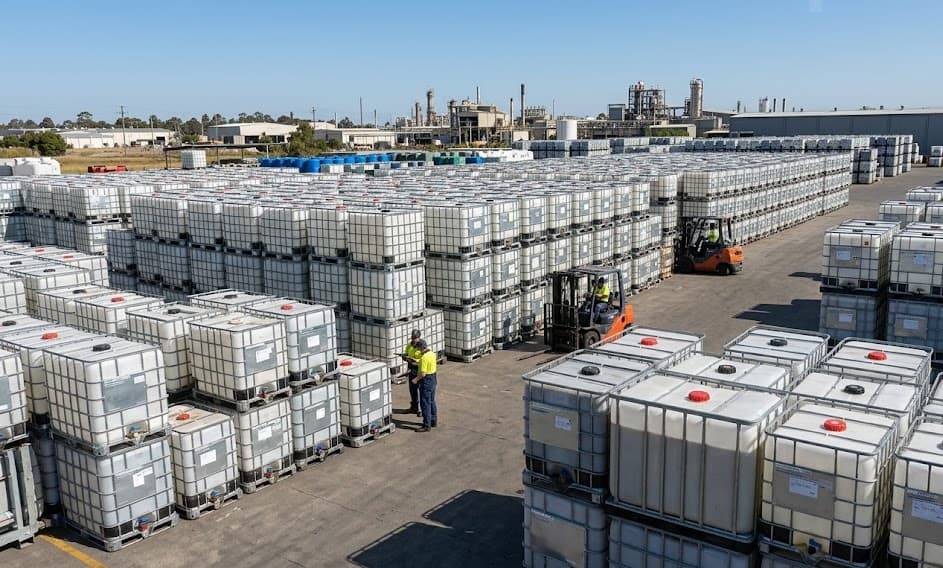
Pharmaceutical-Grade IBC Totes
USP-compliant, fully traceable IBC totes for pharmaceutical manufacturing, bioprocessing, and clean room environments.
Get a Free Quote
Pharmaceutical Industry Standards
The pharmaceutical industry operates under the most stringent quality and regulatory frameworks of any sector. Every component that contacts a drug product, including storage and transport containers, must be qualified, documented, and traceable. IBC totes used in pharmaceutical environments are subject to FDA 21 CFR Part 211 (cGMP for finished pharmaceuticals), USP General Chapters for container specifications, and ICH guidelines for stability and packaging. At Cleveland IBC Recycling, we understand these requirements and maintain a dedicated inventory of pharmaceutical-grade IBC totes that meet the documentation, cleanliness, and material standards that the industry demands.
Pharmaceutical Applications
USP Purified Water
USP purified water and Water for Injection (WFI) are foundational to pharmaceutical manufacturing. IBC totes used for USP water storage must be manufactured from FDA-approved, USP-compliant materials that do not leach extractables or particulates into the water. New, virgin HDPE totes are the standard for this application, and Cleveland IBC Recycling stocks compliant containers specifically for pharmaceutical water systems.
Excipients & Inactive Ingredients
Liquid excipients such as propylene glycol, glycerin, polyethylene glycol (PEG), and various buffer solutions are commonly received and stored in IBC totes. These ingredients, while inactive, must meet the same purity standards as active ingredients to ensure final product quality. Dedicated containers with full traceability are essential.
Active Pharmaceutical Ingredients
API intermediates and dissolved active ingredients are transported between synthesis, purification, and formulation stages in sealed IBC totes. The closed-system design minimizes contamination risk and worker exposure. Full chain-of-custody documentation is maintained for every container.
Cleaning & Sanitization Solutions
Pharmaceutical facilities consume large volumes of cleaning and sanitizing agents including sodium hydroxide (CIP solutions), isopropyl alcohol, hydrogen peroxide, and peracetic acid. IBC totes provide efficient bulk storage and feed for clean-in-place (CIP) and sterilize-in-place (SIP) systems.
Bioprocessing Media
Cell culture media, buffer solutions, and nutrient feeds for biopharmaceutical production are stored in IBC totes designed for bioprocessing environments. Single-use liners within rigid IBC frames are increasingly popular for eliminating cleaning validation requirements.
Waste Streams
Pharmaceutical waste streams including spent solvents, process water, and rejected batches must be contained and transported in compliant containers. IBC totes provide secure, labeled containment for pharmaceutical waste awaiting treatment or disposal.
Compounding Pharmacy Supplies
Compounding pharmacies use IBC totes for bulk receipt of base ingredients including sterile water, saline solutions, and liquid excipients. The sealed container maintains sterility until the product is needed for compounding operations. New, virgin totes with material certificates are required for these applications.
Vaccine Production Support
Vaccine manufacturing requires large volumes of media, buffers, and processing chemicals that are efficiently stored in pharmaceutical-grade IBC totes. The containers support the scale-up from development to full production while maintaining the stringent quality controls that vaccine production demands.
cGMP Detailed Requirements
Current Good Manufacturing Practice (cGMP) regulations under 21 CFR Part 211 establish the framework for pharmaceutical container management. These regulations are enforced by the FDA through routine inspections and have direct implications for IBC tote selection, qualification, and use. Here are the specific CFR sections that apply to container management.
Equipment Construction
Containers used in pharmaceutical manufacturing must be constructed of materials that will not be reactive, additive, or absorptive to the drug product. This means IBC tote materials must be inert with respect to the specific pharmaceutical product they contact. Material compatibility studies are required for each drug-container combination.
Container Requirements
Drug product containers and closures must meet USP requirements for the specific type of product. They must not interact with the drug product to alter its quality, purity, strength, or identity. Containers must be clean and, where appropriate, sterilized prior to use.
Receipt and Storage of Components
Components (including those received in IBC totes) must be examined visually for damage, contamination, or incorrect labeling upon receipt. Each container must be identified with a distinctive code that can be traced to the receipt history. Containers must be stored under conditions that prevent contamination, mix-ups, and degradation.
Drug Product Containers
Containers used for drug products must be clean, stored properly, and inspected before use. Container closure systems must provide adequate protection against foreseeable external factors that can cause contamination or deterioration of the drug product.
Laboratory Controls
Laboratory testing of containers includes verification that materials meet specifications, testing for extractables and leachables, and confirming compatibility with the drug product. Test methods must be validated and calibrated instruments must be used.
Component Records
Complete records must be maintained for each shipment of components received in IBC totes. Records must include the identity, quantity, supplier, lot number, date of receipt, results of any testing, disposition decision, and the name of the person responsible.
Relevant USP Chapters
The United States Pharmacopeia (USP) publishes General Chapters that define testing requirements, specifications, and guidance for pharmaceutical packaging systems. The following chapters are directly relevant to IBC totes used in pharmaceutical manufacturing.
Packaging and Storage Requirements
Defines container types (well-closed, tight, hermetic, light-resistant) and specifies the performance requirements for each. IBC totes used for pharmaceutical storage must meet the container type specified in the individual drug product monograph. Most liquid pharmaceuticals require "tight" containers that protect against loss, contamination, and deleterious changes.
Plastic Packaging Systems
Establishes testing requirements for plastic containers used in pharmaceutical applications. Tests include identification (IR spectroscopy), heavy metals extraction, nonvolatile residue, and buffering capacity. HDPE containers must pass these tests to be considered suitable for pharmaceutical use. Cleveland IBC Recycling provides containers that have been tested per USP <661> specifications.
Assessment of Extractables
Provides guidance on designing extractables studies for pharmaceutical containers. Extractables are chemical compounds that can be removed from container materials under aggressive laboratory conditions (elevated temperature, extreme pH, organic solvents). These studies identify potential leachables and inform the development of leachables testing methods.
Assessment of Drug Product Leachables
Provides guidance on identifying and quantifying leachables in drug products. Leachables are compounds that migrate from the container into the drug product under normal storage conditions. Leachables studies are required for all drug products in plastic containers and inform the setting of specification limits for container quality control.
Visible Particulates in Injections
While primarily focused on the final drug product, this chapter has implications for containers used in the production process. IBC totes used for WFI and injectable-grade components must not contribute visible particles to the product. This requirement drives the need for clean, new, virgin totes for these applications.
Validation Protocols
Pharmaceutical-grade IBC totes require formal validation before they can be used in production. The validation lifecycle follows the standard IQ/OQ/PQ framework and includes ongoing process verification to ensure consistent container quality throughout the product lifecycle.
Installation Qualification (IQ)
IQ for IBC totes verifies that the containers received match the approved specifications. This includes confirming the manufacturer, material grade (HDPE resin type), dimensions, volume capacity, valve type, gasket material, and UN rating (if applicable). Physical inspection and comparison against the approved container specification document are performed on each incoming lot.
Operational Qualification (OQ)
OQ verifies that the IBC totes perform as intended under the expected operating conditions. This includes testing the valve for proper flow rate, leak testing at rated pressure, confirming temperature tolerance range, and verifying compatibility with the intended product through immersion testing. OQ is typically performed on samples from each new lot of containers.
Performance Qualification (PQ)
PQ demonstrates that the IBC totes consistently perform as expected during actual production use. This involves monitoring container performance during a defined number of production batches, testing the stored product at intervals for evidence of container-related contamination, and documenting that the containers meet all predetermined acceptance criteria throughout their intended service life.
Ongoing Process Verification
After initial validation, ongoing monitoring ensures that container quality remains consistent. This includes periodic extractables and leachables testing, incoming inspection of each shipment, monitoring for supplier changes or deviations, and annual review of container performance data. Any out-of-specification result triggers a deviation investigation and potential revalidation.
Change Control for Containers
Any change to a qualified pharmaceutical container system must go through a formal change control process. Changes to the container manufacturer, material, design, or cleaning procedure can affect product quality and regulatory status. The following table outlines common container changes and their impact.
| Change Type | Impact | Required Actions |
|---|---|---|
| Container Manufacturer Change | High | Full revalidation required. New IQ/OQ/PQ protocol. Extractables and leachables testing on new manufacturer product. Stability study with drug product in new container. Regulatory filing may be required depending on drug product type. |
| Resin Grade Change | High | New extractables study required. Leachables assessment with drug product. Material certificate review. Physical property testing (density, melt index). Container specification update. |
| Container Size Change | Medium | Updated IQ for new dimensions. Surface area to volume ratio assessment for leachables impact. Storage and handling procedure updates. No regulatory filing typically required if same material. |
| Valve or Gasket Change | Medium | Material compatibility verification. Extractables testing on new valve/gasket. Functional testing (flow rate, leak test). Updated container specification. |
| Cleaning Procedure Change | Medium-High | Cleaning validation required for new procedure. Rinse water testing for residuals. Product contact surface cleanliness verification. Updated SOP and training. |
Supplier Qualification
Pharmaceutical companies must qualify their IBC tote suppliers as part of their vendor management program. Cleveland IBC Recycling supports this process by providing all necessary documentation, facilitating audits, and maintaining the quality systems that pharmaceutical customers require.
Supplier Assessment
Initial evaluation of the IBC tote supplier includes review of their quality management system (ISO 9001 certification minimum), manufacturing capabilities, material sourcing, and quality control procedures. A supplier questionnaire covers all relevant cGMP requirements. For pharmaceutical-grade totes, suppliers must demonstrate controlled manufacturing environments and documented quality systems.
Material Review
Review material certificates of conformance, resin specifications, and processing conditions. Verify that all materials meet FDA 21 CFR and USP requirements. Request and review extractables data for the specific resin grade used in the totes. Confirm that no recycled or regrind material is used in pharmaceutical-grade containers.
On-Site Audit
Conduct an on-site audit of the supplier manufacturing facility. Verify cleanliness of the production environment, material handling procedures, container testing protocols, storage conditions, and traceability systems. Review CAPA history, complaint handling, and deviation management processes. Document findings in an audit report.
Sample Testing
Obtain sample containers from the supplier and perform incoming quality testing per your container specification. This includes dimensional verification, visual inspection, extractables testing, and functional testing (valve operation, leak test). Compare results against predetermined acceptance criteria.
Qualification Report
Compile all supplier assessment, material review, audit, and testing data into a supplier qualification report. The report includes a recommendation for approval, conditional approval, or rejection. Approved suppliers are added to the Approved Supplier List (ASL) and assigned a requalification schedule (typically annual or biennial).
Cleaning Validation
Cleaning validation demonstrates that the cleaning procedure for IBC totes consistently removes product residues, cleaning agent residues, and microbial contamination to acceptable levels. For pharmaceutical applications, cleaning validation is a regulatory requirement, not an option.
Cleaning Validation Protocol
A written protocol defines the scope of the cleaning validation study, including the cleaning procedure being validated, the residues to be tested for (previous product, cleaning agent, microbial), the acceptance criteria, the sampling methods (swab, rinse, or both), the analytical methods, and the number of cleaning cycles to be validated (minimum three consecutive successful runs).
Acceptance Criteria
Cleaning acceptance limits are typically set using one of three approaches: the 1/1000th dose criterion (residue of the previous product must not exceed 1/1000th of the therapeutic dose in the maximum daily dose of the next product), the 10 ppm criterion (residue concentration in the next product must not exceed 10 ppm), or visual cleanliness (no visible residue on the container surface). The most restrictive criterion applies.
Sampling Methods
Swab sampling involves wiping a defined area of the container interior surface with a validated swab and analyzing the swab extract for residues. Rinse sampling involves filling the cleaned container with a measured volume of solvent, agitating, and analyzing the rinse solution. Both methods may be used in combination. Sampling locations must include worst-case areas such as the valve, lid, and bottom corners.
Analytical Methods
Validated analytical methods must be used for residue quantification. Common methods include HPLC (for specific product residues), TOC analysis (for total organic carbon as a non-specific measure), conductivity (for inorganic residues), and pH. Method validation must demonstrate specificity, linearity, accuracy, precision, limit of detection, and limit of quantification in the cleaning matrix.
Endotoxin Testing & Bioburden Control
For IBC totes used in injectable drug manufacturing, biopharmaceutical production, and sterile compounding, endotoxin and bioburden control are critical quality attributes. These tests verify that the container does not introduce biological contamination into the pharmaceutical product.
Endotoxin Testing (LAL)
Endotoxins are cell wall fragments from gram-negative bacteria that can cause pyrogenic reactions in patients. For IBC totes used to store WFI or injectable-grade components, endotoxin testing of rinse water from the container surface may be required. The Limulus Amebocyte Lysate (LAL) test is the standard method. Acceptance limits are typically 0.25 EU/mL for WFI and vary for other products based on the route of administration and dose.
Bioburden Testing
Bioburden testing quantifies the total number of viable microorganisms on the container surface or in the rinse water. For pharmaceutical-grade IBC totes, bioburden testing may be required after cleaning and before use. Common methods include membrane filtration and pour plate techniques. Acceptance limits are defined in the cleaning validation protocol and typically require a Total Aerobic Microbial Count (TAMC) below a defined limit.
Environmental Monitoring
The storage area for pharmaceutical-grade IBC totes should be subject to environmental monitoring for particulates and microorganisms. While a full clean room classification is not always required, controlled temperature, humidity, and cleanliness conditions should be maintained. Air sampling, surface sampling, and personnel monitoring may be included in the environmental program.
Container Closure Integrity
After cleaning and before use, the container closure system (lid, gaskets, valve) must maintain integrity to prevent microbial ingress during storage. Testing may include dye ingress testing, pressure decay testing, or microbial challenge testing. The container should be sealed with tamper-evident closures and stored in a controlled environment until use.
Shelf Life Considerations
Pharmaceutical containers have a finite service life that must be tracked and managed. Material aging, environmental exposure, and mechanical stress all affect container performance over time.
Container Service Life
HDPE IBC totes have a finite service life for pharmaceutical applications. New virgin totes are typically assigned a container service life of 5 years from the date of manufacture for general pharmaceutical use. For UN-rated containers, the service life is fixed at 5 years by regulation. Beyond this period, the container must be requalified or retired.
Material Aging Effects
Over time, HDPE undergoes slow oxidative degradation, UV damage (if exposed to light), and mechanical fatigue from repeated filling and emptying. These aging effects can increase extractables levels, reduce impact resistance, and compromise container closure integrity. Annual or biennial testing of in-service containers is recommended.
Product Stability in Containers
Drug products and pharmaceutical ingredients stored in IBC totes must undergo stability testing per ICH guidelines. Stability studies evaluate the product in its actual container at the intended storage conditions over the defined shelf life. Any degradation or changes attributed to the container trigger a reassessment of container suitability.
Reuse Limitations
In pharmaceutical applications, container reuse is highly restricted. New virgin totes are required for drug product contact applications. Reconditioned totes may be used for non-product-contact applications such as cleaning solutions, waste streams, and utility water. The decision to reuse must be documented and justified based on a risk assessment.
New vs. Reconditioned for Pharma
New Virgin Totes
- ✓Required for USP water, WFI, and direct drug-contact applications
- ✓No prior-contents history to validate
- ✓Full material certificates of conformance included
- ✓Extractables and leachables data available
- ✓Clean room packaging available on request
- ✓Full 5-year service life from date of manufacture
- ✓Supports FDA inspection and regulatory filing requirements
Reconditioned Totes
- ✓Suitable for cleaning solutions, waste streams, and non-product-contact uses
- ✓Prior-contents documentation provided
- ✓Professional multi-step cleaning with documentation
- ✓Significant cost savings over new containers
- ✓Supports sustainability goals and waste reduction
- ✓Risk assessment documentation support provided
- ✓Ideal for utility applications within pharmaceutical facilities
Pharmaceutical-Grade Containers
Cleveland IBC Recycling partners with pharmaceutical manufacturers and bioprocessing facilities to provide the right containers for the right applications, with the documentation and traceability your quality team requires. Contact us to discuss your specifications.
We understand that pharmaceutical container procurement is a quality-critical process, not just a purchasing decision. Our team is prepared to support your supplier qualification process, provide comprehensive documentation packages, and work within your change control framework to ensure a smooth, compliant container supply.