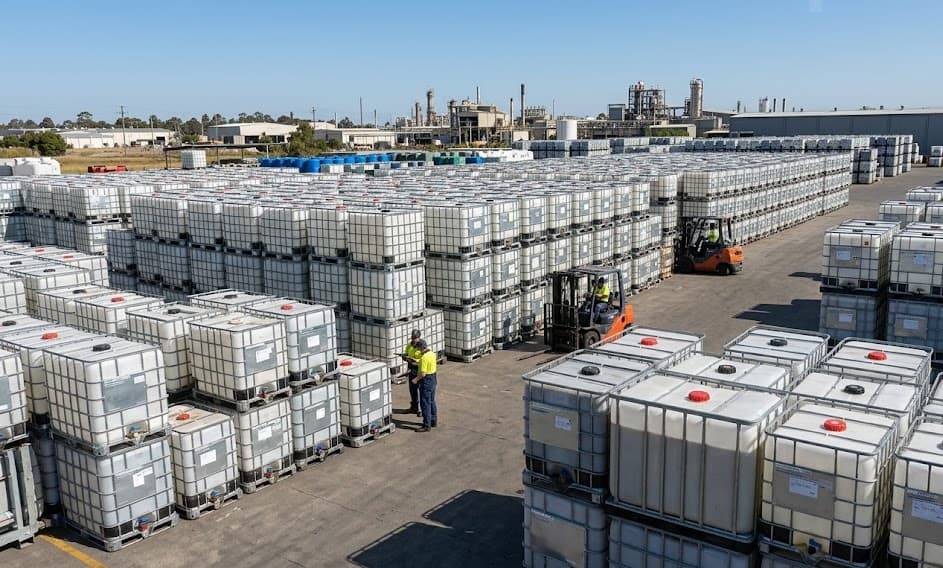
Shipping hazardous materials in IBC containers is governed by a comprehensive regulatory framework designed to protect workers, the public, and the environment from the risks posed by dangerous goods in transit. In the United States, the primary regulatory authority is the Department of Transportation's Pipeline and Hazardous Materials Safety Administration, which enforces the Hazardous Materials Regulations codified in Title 49 of the Code of Federal Regulations. International shipments are additionally governed by the International Maritime Dangerous Goods Code for ocean transport, the International Air Transport Association Dangerous Goods Regulations for air transport, and the UN Recommendations on the Transport of Dangerous Goods, which provide the harmonized framework that national regulations are based on.
The first step in shipping hazmat in an IBC is to properly classify the material being shipped. Every hazardous material has a UN number (a four-digit identifier assigned by the United Nations), a proper shipping name, a hazard class (1 through 9, covering explosives, gases, flammable liquids, flammable solids, oxidizers, toxic substances, radioactive materials, corrosives, and miscellaneous dangerous goods), and a packing group (I, II, or III) that indicates the degree of danger. You can find this information on the material's Safety Data Sheet, in the DOT Hazardous Materials Table (49 CFR 172.101), or from the material's manufacturer or distributor. Correct classification is the foundation of everything that follows — errors in classification can result in using the wrong packaging, applying incorrect labels, and completing shipping documents improperly.
Once you know the material's classification, you need to verify that your IBC container is authorized for shipping that specific material. The Hazardous Materials Table specifies which packaging types are authorized for each material, identified by their UN packaging codes. For composite IBCs (the most common type), the relevant codes are 31HA1 (rigid plastic inner receptacle with metal outer cage) and 31HH1 (rigid plastic inner receptacle with plastic outer structure). The table also specifies the required packing group rating — your IBC must be rated at or above the packing group of the material being shipped. A tote rated "Y" (Packing Group II) can carry Packing Group II and III materials but not Packing Group I.
The IBC must be within its certified service life. Under 49 CFR 180.352, composite IBCs used for hazardous materials transport must undergo a periodic inspection and test every 2.5 years and have a maximum service life of 5 years from the date of manufacture. The date of manufacture is stamped on the UN marking plate on the container. Using an IBC that has exceeded its 5-year service life for hazmat transport is a violation, even if the container appears to be in perfect physical condition. Metal IBCs (stainless steel) are not subject to the 5-year limit but must still undergo periodic inspections.
The 2.5-year inspection and test for composite IBCs includes a visual inspection of the inner receptacle for cracks, crazing, discoloration, and wall thickness reduction; a check of the outer cage for structural damage, corrosion, and weld integrity; a leak test of the valve and closures; verification that the UN marking plate is legible; and documentation of the inspection results. This inspection can be performed by the IBC owner, a third-party inspection service, or the IBC manufacturer or reconditioner. The inspection date must be marked on the IBC.
Labeling and marking requirements for hazmat IBC shipments are specified in 49 CFR Parts 172.300 through 172.338 (marking) and 172.400 through 172.450 (labeling). Each IBC must be marked with the proper shipping name of the material, the UN number preceded by "UN" (e.g., "UN1993"), and the name and address of the consignee or consignor. Hazard labels — diamond-shaped labels identifying the primary and subsidiary hazards of the material — must be applied to opposite sides of the IBC. The labels must be durable, legible, and of the correct size (at least 100mm x 100mm for IBCs).
Placarding requirements apply to the transport vehicle, not the individual IBC, but shippers need to communicate the hazard information to the carrier so that the vehicle can be placarded correctly. Any shipment of hazmat in IBC quantities typically requires placarding under DOT rules.
Shipping documentation is another critical compliance element. Every hazmat shipment must be accompanied by a shipping paper (also called a dangerous goods declaration or hazmat bill of lading) that includes the proper shipping name, hazard class, UN number, packing group, total quantity, and emergency contact information for the shipper. The shipping paper must be readily accessible to the driver and to emergency responders in the event of an incident. Electronic shipping papers are permitted under current regulations but must be accessible at all times during transport.
Emergency response information must accompany every hazmat shipment. The most common method is to include an Emergency Response Guidebook reference or a 24-hour emergency response phone number on the shipping paper. Many shippers contract with emergency response services such as CHEMTREC to provide round-the-clock hazmat incident assistance.
Training requirements apply to every employee who handles, packages, labels, documents, or transports hazardous materials. Under 49 CFR 172 Subpart H, hazmat employees must receive initial training within 90 days of employment and recurrent training at least every 3 years. Training must cover general awareness, function-specific procedures, safety protocols, and security awareness. Records of training must be maintained and made available to DOT inspectors upon request.
Penalties for non-compliance with hazmat shipping regulations are severe. Civil penalties can reach up to $80,000 or more per violation, and criminal penalties — including imprisonment — apply to knowing violations that result in death, serious injury, or environmental damage. Beyond the regulatory penalties, a hazmat incident caused by improper packaging or documentation can generate enormous cleanup costs, liability claims, and reputational damage.
At Cleveland IBC Recycling, we supply UN-certified IBC totes suitable for hazmat transport and can verify that the containers you purchase meet the regulatory requirements for your specific materials. While we are not a hazmat compliance consulting firm, our team is knowledgeable about the intersection of IBC container specifications and DOT regulations, and we can point you toward the resources you need to ensure full compliance.