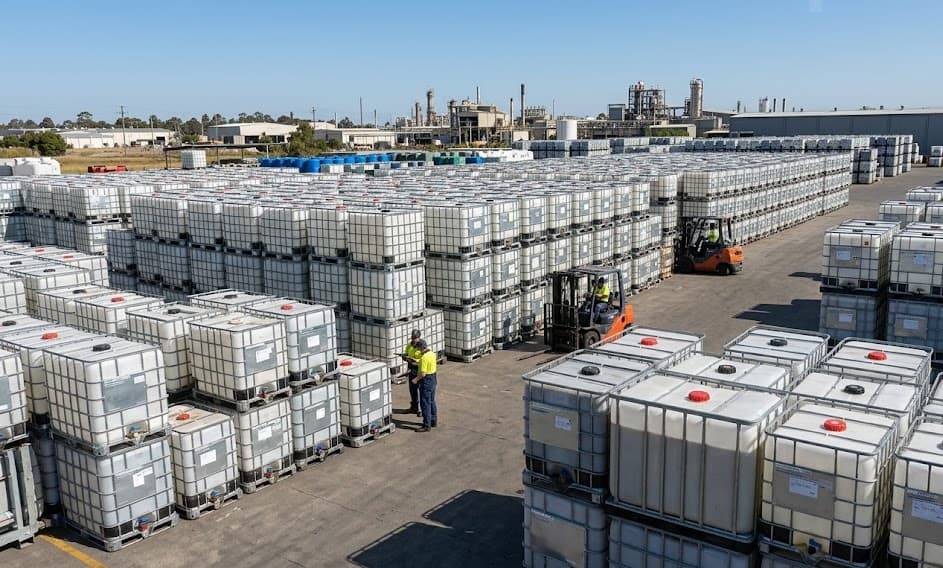
Every IBC tote that is designed for the transport of hazardous materials bears a UN certification mark — a standardized code stamped or embossed on the container that communicates essential information about its construction, capacity, testing, and approved use. Understanding how to read and interpret this marking is not optional for businesses that ship regulated materials; it is a legal requirement under both US Department of Transportation regulations and international transport codes. Even if your business handles non-hazardous liquids, understanding UN certification helps you make better purchasing decisions and avoid compliance pitfalls.
The UN marking system follows a specific format that appears as a series of letters, numbers, and symbols. A typical marking on a composite IBC tote looks something like this: UN 31HA1/Y/0822/USA/MANUFACTURER/5500/1650. Each element in that string conveys a distinct piece of information, and we will decode them one by one.
The "UN" prefix indicates that the container has been manufactured and tested in accordance with United Nations Recommendations on the Transport of Dangerous Goods. This is the international standard adopted by virtually every country's transport regulatory body, including the US DOT, Transport Canada, and the European ADR framework.
The "31HA1" portion is the container type code. The first two digits — "31" — indicate that this is a rigid IBC designed for liquids. Other codes exist for flexible IBCs, fiberboard IBCs, and wooden IBCs, but 31 is the designation you will see on the composite totes that dominate the market. The "H" indicates that the outer packaging is made of metal — specifically, the steel cage. The "A1" specifies that the inner receptacle is rigid plastic (HDPE). So "31HA1" translates to: rigid IBC for liquids with a steel cage and a rigid plastic inner bottle. If you see "31HH1," that indicates an all-plastic IBC with a plastic outer structure instead of steel.
The next character — in this example "Y" — is the packing group designation. There are three packing groups under UN regulations, each corresponding to a level of hazard severity. Packing Group I (marked "X") covers materials with the highest danger level. Packing Group II (marked "Y") covers medium-danger materials. Packing Group III (marked "Z") covers materials with the lowest danger level. A tote marked "Y" is approved for Packing Groups II and III, while one marked "X" is approved for all three groups. A "Z" marking limits the tote to Packing Group III materials only. The packing group of the material you intend to ship must be equal to or lower in hazard level than the tote's rating.
The "0822" element indicates the month and year of manufacture — in this case, August 2022. This date is critical because UN-certified IBCs have a limited service life for the transport of hazardous materials. Under DOT regulations (49 CFR 180.352), a composite IBC used for hazmat transport must undergo a periodic retest and inspection every 2.5 years and has a maximum service life of 5 years from the date of manufacture. After five years, the tote can no longer be used for hazmat shipment, even if it appears to be in perfect condition. It can still be used for non-hazardous materials, but its UN certification for regulated transport expires.
"USA" identifies the country whose competent authority authorized the design type. For totes sold in the United States, this will almost always be "USA," indicating that the container design was approved by the DOT's Pipeline and Hazardous Materials Safety Administration. The manufacturer name or code follows, identifying the company that produced the container.
The "5500" figure represents the maximum allowable gross mass in kilograms — that is, the combined weight of the container and its contents when fully loaded. This number sets the upper limit for how much the tote can weigh during transport. Exceeding this weight violates the certification and creates a safety hazard. For a standard 275-gallon composite IBC, the maximum gross mass is typically in the range of 1,500 to 2,400 kilograms, depending on the specific design.
The final number — "1650" in our example — indicates the maximum stacking load in kilograms. This tells you how much weight can be placed on top of the tote during storage and transport. It is expressed as the total load that can bear down on the tote, including the weight of any containers stacked above it. Exceeding the stacking load rating can cause the cage to deform and the inner bottle to rupture.
For businesses that ship hazardous materials, compliance with UN certification requirements is non-negotiable. Using an expired, improperly marked, or inadequately rated IBC for hazmat transport can result in DOT enforcement actions, fines, and liability exposure in the event of an incident. Before loading a regulated material into any IBC tote, verify that the UN marking is legible, the container is within its service life, the packing group rating matches or exceeds the material's classification, and the gross mass limit will not be exceeded.
For businesses that handle only non-hazardous materials, UN certification is less of a regulatory concern but still a useful quality indicator. A tote that was originally manufactured to UN standards was built to tighter tolerances and subjected to more rigorous testing — including drop tests, stacking tests, hydraulic pressure tests, and leakproof tests — than a non-certified container. Buying UN-certified used or reconditioned totes gives you a container with a documented pedigree, even if you never intend to ship hazmat.
At Cleveland IBC Recycling, we inspect and document the UN markings on every tote in our inventory. Our team can help you identify the right certification level for your shipping needs and ensure that the containers you purchase are compliant with DOT and international transport regulations. If you are unsure about the regulatory requirements for your specific materials, we recommend consulting with a hazmat compliance specialist or contacting the DOT directly for guidance.