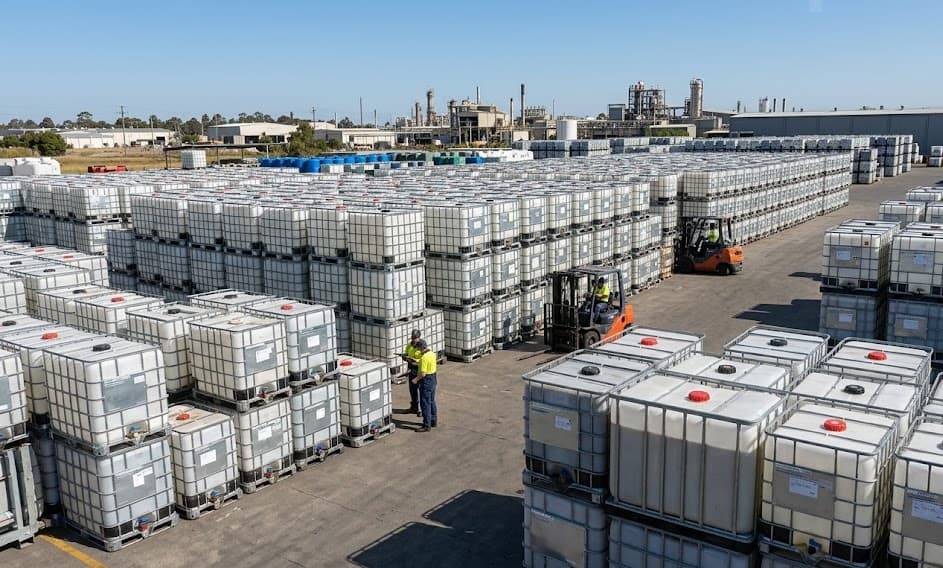
The intermediate bulk container, or IBC, is a relatively recent innovation in the long history of industrial packaging, yet it has become so ubiquitous that it is easy to take for granted. Understanding how and why the IBC was developed provides useful context for appreciating its design strengths and its dominant position in the bulk liquid packaging market.
The problem that IBCs were designed to solve is straightforward: how to efficiently store, transport, and dispense liquids in quantities that fall between a 55-gallon drum and a full tanker truck. Before IBCs, the 55-gallon steel drum was the default container for bulk liquids, and it had been since the early 20th century. Drums work well for their size range, but when operations need 200, 300, or more gallons of liquid at a time, drums become inefficient. Handling five individual drums instead of one 275-gallon container multiplies labor, increases the risk of spills and injuries, wastes warehouse space, and adds transportation costs.
Tank trailers and rail cars serve the high end of the volume spectrum, but they are impractical for many operations that need intermediate quantities. A small manufacturer might use 300 gallons of a solvent per week — too much for drums, too little for a tanker delivery. The IBC fills that gap, providing a standardized, forklift-compatible container that holds a meaningful volume while remaining manageable for a typical warehouse or production facility.
The first IBCs appeared in the 1970s and early 1980s in Europe, where the chemical and food industries were early adopters. These early designs included rigid containers made from stainless steel, carbon steel, and plastics, as well as flexible bulk bags for dry materials. The rigid IBC for liquids evolved through several design generations before converging on the composite design — an HDPE inner bottle inside a welded steel cage on a pallet base — that dominates the market today.
The composite IBC design was a breakthrough because it combined the chemical resistance and light weight of plastic with the structural strength and stackability of steel. The HDPE inner bottle provides a seamless, non-corrosive vessel that resists a wide range of chemicals and can be blow-molded in a single piece, eliminating the seams and joints that are potential leak points in metal containers. The galvanized steel cage surrounds the bottle and provides the rigid framework needed for stacking, forklift handling, and physical protection during transport. The integrated pallet base — typically wood, steel, or plastic — allows the tote to be handled by standard warehouse equipment without a separate pallet.
Standardization was a critical factor in the IBC's rapid adoption. The UN Committee of Experts on the Transport of Dangerous Goods established testing and certification standards for IBCs in the 1980s, which were subsequently adopted by national transport authorities around the world. The UN performance standards — covering drop tests, stacking tests, hydraulic pressure tests, leakproof tests, and vibration tests — ensured that IBCs from any manufacturer could be relied upon to meet minimum safety requirements. This standardization gave buyers confidence in the product and allowed IBC designs to become interchangeable across global supply chains.
The 1990s saw explosive growth in IBC adoption, driven by several converging trends. First, the chemical industry was globalizing rapidly, and IBCs offered a packaging solution that was compatible with the shipping infrastructure of every major economy. Second, the food and beverage industry recognized the advantages of IBCs for ingredients like juice concentrates, edible oils, and flavorings, creating a huge new market for food-grade containers. Third, environmental regulations in Europe and North America increasingly penalized waste generation and encouraged packaging reuse, and the reconditioning and recycling model that developed around IBCs aligned perfectly with these regulatory trends.
The turn of the millennium brought refinements to IBC design and manufacturing. Blow-molding technology improved, allowing thinner, lighter inner bottles that maintained equivalent strength and chemical resistance. New HDPE formulations with enhanced UV stabilizers extended outdoor service life. Valve technology evolved from basic gate valves to sophisticated butterfly and ball valve assemblies with quick-connect fittings. Anti-static and conductive IBC designs were developed for handling flammable liquids in explosive atmospheres.
The reconditioning industry that grew up alongside IBC manufacturing became a significant business in its own right. Companies specializing in collecting, cleaning, testing, and reselling used IBCs created a secondary market that reduced the effective cost of IBC packaging and extended the useful life of containers. The reconditioning model also generated environmental benefits by diverting millions of containers from landfills and reducing demand for virgin materials. Today, the IBC reconditioning industry processes millions of containers annually worldwide.
In the 2020s, IBC innovation continues on several fronts. Smart IBCs equipped with IoT sensors can monitor fill levels, temperature, and location in real time, enabling more efficient inventory management and supply chain visibility. Lightweight designs using advanced polymers and thinner steel aim to reduce tare weight and transportation costs. Improved recycling technologies are recovering higher-quality recycled HDPE from end-of-life bottles, enabling closed-loop manufacturing where old bottles are turned into new ones.
The IBC market today is estimated at well over a billion dollars globally and continues to grow as industries discover new applications for these versatile containers. From their origins as a European niche product in the 1970s, IBCs have become a cornerstone of industrial, agricultural, food, and chemical logistics worldwide.
Here in Cleveland, IBC totes are an integral part of the regional economy. Manufacturing, food processing, chemical production, and agriculture across Northeast Ohio all depend on a reliable supply of IBC containers, and companies like Cleveland IBC Recycling keep those containers circulating through the regional economy — buying, reconditioning, reselling, and recycling them to ensure that the environmental and economic benefits of the IBC system are fully realized.