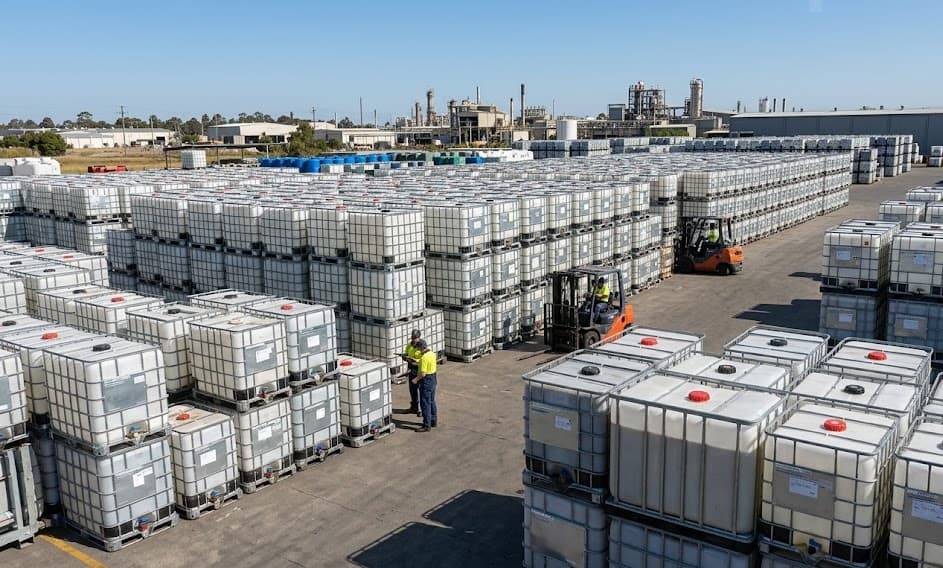
For businesses that use IBC totes, container costs are a recurring line item that directly affects operating margins. The decision between buying new and buying used or reconditioned totes has a significant financial impact, particularly at volume. This analysis walks through the real numbers to help you understand the savings potential and make an informed purchasing decision.
Let us start with the baseline cost of a new composite IBC tote. Prices fluctuate with resin costs and market demand, but as of 2025, a standard new 275-gallon composite IBC tote with a 2-inch butterfly valve typically costs between $350 and $550, depending on the manufacturer, specification, and order volume. Food-grade new totes with UN certification and premium fittings can push toward $600 or more. For this analysis, we will use an average new tote cost of $450.
A reconditioned IBC tote — cleaned, inspected, with new valve and gaskets — costs between $125 and $225 depending on the grade and the reconditioner. Grade A reconditioned totes command the higher end of that range, while Grade B totes fall in the middle. We will use an average reconditioned cost of $175. A used but uncleaned tote, sold as-is in Grade B or C condition, typically costs between $75 and $125. We will use $100 as the average for a used as-is tote.
For a business that purchases 50 totes per year, the annual container cost at new prices is $22,500. The same business buying reconditioned totes spends $8,750 — a savings of $13,750, or 61 percent. Buying used as-is totes (assuming in-house cleaning capability) drops the cost to $5,000, saving $17,500 or 78 percent compared to new. These are straight purchase-price comparisons, but the total cost of ownership picture includes additional factors.
Service life is one such factor. A new composite IBC tote has an expected service life of 5 to 7 years under normal use conditions. A reconditioned tote has already used some of that service life, so its remaining useful life depends on its age, condition, and the products it has held. A Grade A reconditioned tote that has been used once and is only one to two years old may have 4 to 6 years of remaining life — nearly equivalent to a new tote. A Grade B tote that is three to four years old and has been through two or three use cycles might have 2 to 3 years of remaining life. When you factor in the cost per year of usable life, reconditioned totes still come out ahead in most scenarios, but the advantage narrows for older or lower-grade containers.
Cleaning and preparation costs affect the total cost of ownership for used as-is totes. If you purchase uncleaned totes and clean them in-house, you need to account for labor time (30 to 60 minutes per tote for a thorough cleaning), cleaning chemicals, water, wastewater disposal, and equipment costs. For a facility with existing cleaning infrastructure and trained staff, the marginal cost of cleaning an additional tote might be $15 to $30. For a facility without cleaning capability, the cost of outsourcing cleaning — or the capital investment to build in-house capability — can erode the price advantage of buying as-is totes. This is why many businesses find that buying pre-cleaned reconditioned totes from a professional reconditioner offers the best balance of cost and convenience.
Valve and gasket replacement is another consideration. New totes come with new valves and gaskets. Reconditioned totes from reputable reconditioners like Cleveland IBC Recycling also include new valves and gaskets as standard. Used as-is totes may have worn, leaking, or incompatible valves that need replacement. A standard 2-inch butterfly valve costs $15 to $30, and a gasket costs $3 to $5. These are minor costs individually but add up across a large fleet.
The resale and buyback value of your totes at end of use is part of the total cost equation. When you are finished with a tote, you can sell it back to a reconditioner or recycler rather than paying for disposal. Cleveland IBC Recycling buys back used totes, and the buyback price depends on the tote's condition and the current market. A tote in decent condition might fetch $20 to $60 buyback value. Factoring in the buyback value further reduces the net cost of ownership for both new and used totes.
Transportation and logistics costs are largely the same whether you buy new or used — the totes ship on the same trucks and take up the same space. However, buying from a regional supplier like Cleveland IBC Recycling typically results in lower freight costs than buying new totes from a distant manufacturer or distributor.
For businesses evaluating the new-vs-used decision, we recommend this framework. If your application requires virgin, food-grade containers with no prior contents history — such as pharmaceutical production or certain food applications — new totes may be necessary. If your application requires food-grade containers with documented food-grade history, Grade A reconditioned totes are the sweet spot of quality and value. If your application is general industrial, agricultural, or non-food storage, Grade B reconditioned totes deliver the best overall value. If you have in-house cleaning capability and need containers for non-critical applications, used as-is totes at Grade B or C pricing offer maximum savings.
The bottom line is that for the vast majority of IBC applications, buying reconditioned or used totes saves 50 to 75 percent compared to new, with minimal practical compromise. At Cleveland IBC Recycling, we help businesses across Northeast Ohio optimize their container costs by matching the right grade and condition of tote to each specific application. Contact us for a quote that includes the full cost comparison for your volume and use case.