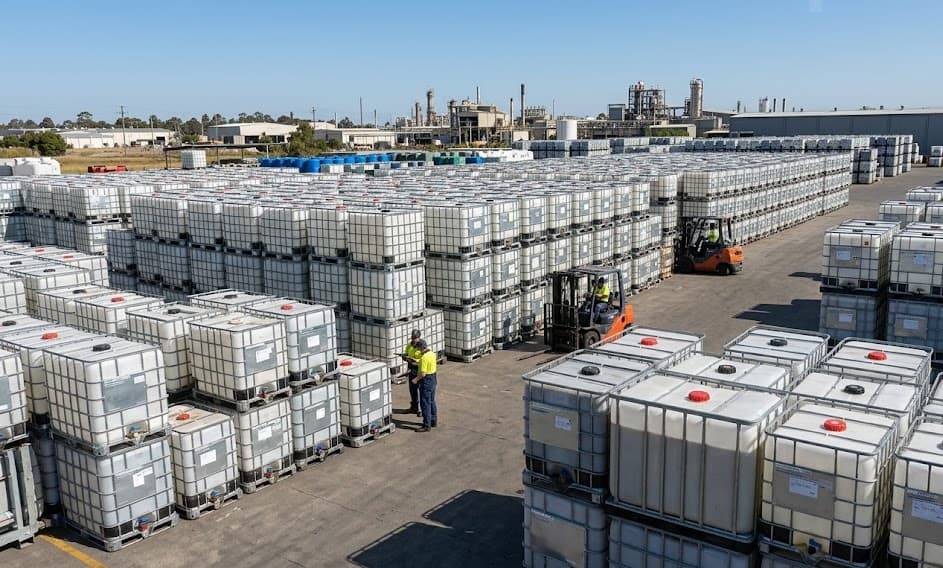
The environmental case for IBC recycling is built on hard numbers, not just feel-good marketing. Every intermediate bulk container that gets reconditioned and returned to service instead of being scrapped and replaced with a new unit avoids a significant amount of carbon dioxide emissions. Understanding the full lifecycle carbon impact of an IBC tote helps businesses quantify the environmental value of choosing recycled containers and strengthens their sustainability reporting.
Manufacturing a new IBC tote from virgin materials is an energy-intensive process. The HDPE inner bottle requires the extraction and refining of petroleum feedstock, the polymerization of ethylene into high-density polyethylene resin, and the blow molding of that resin into a container. The steel cage demands iron ore mining, smelting, and welding. The wooden or plastic pallet base adds its own material and processing footprint. When you add up the embedded energy across all components, a single new 275-gallon composite IBC tote carries an estimated carbon footprint of 150 to 200 kilograms of CO2 equivalent. That figure includes raw material extraction, manufacturing, and transportation to the end user.
Reconditioning a used tote, by contrast, skips the most carbon-intensive steps entirely. The existing HDPE bottle, steel cage, and pallet base are retained and restored rather than replaced. The reconditioning process — which typically involves cleaning, pressure testing, valve replacement, and minor cage repair — consumes a fraction of the energy required to manufacture those components from scratch. Industry estimates suggest that reconditioning an IBC tote produces roughly 70 to 85 percent fewer carbon emissions than manufacturing a new one. For a business that cycles through 100 totes per year, switching from new to reconditioned containers could eliminate 10 to 15 metric tons of CO2 annually.
Water conservation is another environmental benefit that often gets overlooked. Manufacturing virgin HDPE resin and processing steel both require substantial water inputs for cooling, cleaning, and chemical processing. A reconditioning facility uses water too — primarily for cleaning the totes — but the total water consumption per container is dramatically lower than what is needed to produce one from raw materials. At Cleveland IBC Recycling, we use a closed-loop water treatment system that recycles wash water through multiple cleaning cycles, further reducing our freshwater consumption per tote.
The waste diversion angle is equally compelling. When an IBC tote reaches true end of life and can no longer be safely reconditioned, responsible recyclers disassemble the container and channel each component into the appropriate recycling stream. The HDPE bottle is shredded and pelletized for reuse in plastic manufacturing. The steel cage goes to a metal recycler for melting and reprocessing. Even the wooden pallet can be chipped for mulch or biomass fuel. A zero-landfill recycling operation ensures that virtually nothing from an IBC tote ends up in a disposal site, which avoids the methane emissions associated with organic waste decomposition in landfills and the environmental contamination risks of plastic waste.
Transportation emissions are another factor in the carbon equation. New IBC totes are often manufactured overseas — primarily in China and Southeast Asia — and shipped to North American distributors by container vessel, then trucked to the end user. That intercontinental supply chain generates substantial transportation-related emissions. Reconditioned totes sourced from a regional supplier like Cleveland IBC Recycling travel a fraction of that distance. Our service area spans Northeast Ohio and surrounding states, meaning most deliveries involve a short truck haul rather than a transoceanic voyage followed by cross-country freight.
For businesses with formal sustainability programs, ESG reporting requirements, or B Corp certification goals, the carbon savings from IBC recycling can be documented and reported with confidence. We provide certificates of recycling and reconditioning that include the number of containers processed, the estimated carbon savings, and the materials diverted from landfill. These documents plug directly into sustainability reports and demonstrate tangible progress toward emissions reduction targets.
The circular economy model that IBC recycling represents is one of the most practical examples of industrial sustainability. Rather than a linear take-make-dispose path, each tote cycles through multiple use phases — first use, reconditioning, second use, reconditioning again — before finally being disassembled and its materials returned to the manufacturing stream. Each cycle extends the useful life of the embedded energy and materials, spreading the initial carbon cost across more units of productive service.
Businesses in the food and beverage, chemical, agricultural, and manufacturing sectors are the largest users of IBC totes, and they are also under increasing pressure from regulators, investors, and consumers to demonstrate environmental responsibility. Switching from virgin containers to reconditioned ones is a concrete, immediately implementable step that delivers measurable carbon reductions without requiring capital investment in new equipment or processes. It is one of the simplest sustainability wins available to operations that depend on bulk liquid storage and transport.
If your company is evaluating its carbon footprint and looking for practical reduction strategies, IBC recycling deserves a spot near the top of the list. The savings are real, the documentation is available, and the switch from new to reconditioned totes is seamless from an operational standpoint. Contact Cleveland IBC Recycling to learn how many tons of CO2 your organization could save by incorporating recycled containers into your supply chain.