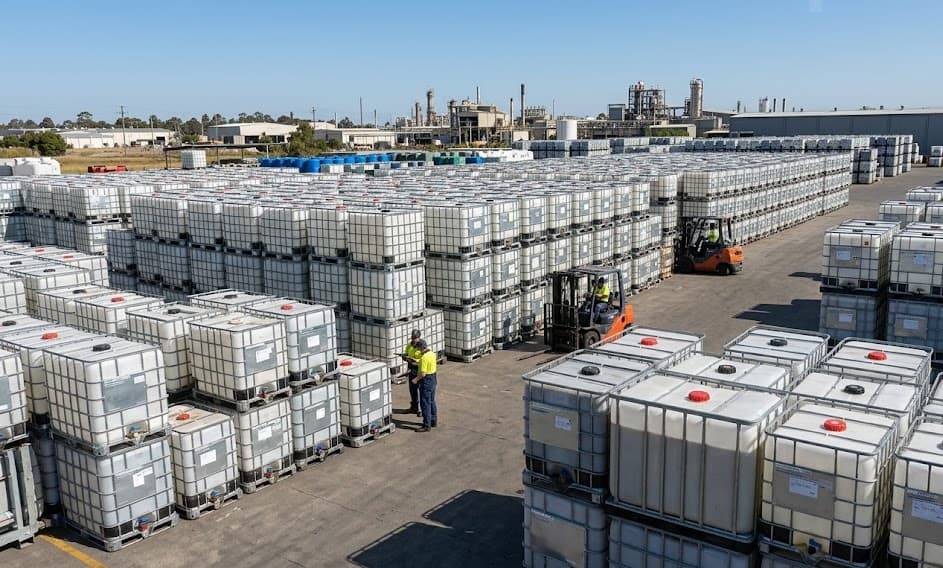
The 55-gallon steel drum has been the default container for bulk liquids for over a century, but a growing number of businesses are discovering that IBC totes offer superior economics, efficiency, and safety for most liquid handling applications. The shift from drums to totes is not a passing trend — it reflects fundamental advantages that compound as operations scale. Here is a detailed look at why businesses across manufacturing, food processing, agriculture, and chemical distribution are making the switch.
Capacity is the most obvious differentiator. A standard IBC tote holds 275 gallons — five times the volume of a single 55-gallon drum. That means one tote replaces five drums, which has cascading benefits across storage, handling, and transportation. A warehouse that previously needed floor space for 100 drums can store the same total volume in just 20 totes, freeing up significant real estate for production equipment, inventory, or staging areas. The space savings alone can justify the switch for operations that pay premium rates for warehouse square footage.
Handling efficiency improves dramatically with IBC totes. Moving five individual drums requires five separate forklift operations — position, lift, transport, and place — each with its own time cost and risk of incident. Moving one IBC tote that holds the same volume takes a single forklift operation. For a facility that processes hundreds of containers per week, the labor savings are substantial. Workers spend less time on repetitive material handling and more time on value-added tasks. Fewer individual container movements also mean fewer opportunities for drops, spills, and musculoskeletal injuries.
Dispensing liquid from an IBC tote is simpler and cleaner than from a drum. Totes come equipped with a butterfly or ball valve at the bottom that allows gravity-fed or pump-assisted dispensing with precise flow control. Drums require a bung wrench to open the top, a siphon pump or tilting cradle to extract the liquid, and careful handling to avoid splashing. The tote valve connects directly to hoses, pumps, and downstream equipment, creating a cleaner and more ergonomic workflow.
Transportation costs decrease when you consolidate from drums to totes. A standard 53-foot trailer can carry approximately 80 IBC totes stacked two high, holding a total of about 22,000 gallons. Achieving the same volume with 55-gallon drums would require roughly 400 containers, which take up more space and add more tare weight per gallon of product shipped. The result is more product per truckload, fewer shipments per year, and lower freight costs per gallon. For businesses that ship liquid products regionally or nationally, the transportation savings can be the single largest financial benefit of the switch.
Inventory management becomes more straightforward with fewer, larger containers. Tracking 20 totes is simpler than tracking 100 drums, whether you use a barcode system, RFID tags, or manual logs. Fewer containers mean fewer labeling errors, fewer misplaced units, and faster cycle counts. The flat surfaces and standardized dimensions of IBC totes also make them easier to label clearly and consistently compared to the curved surface of drums.
Product yield and waste reduction favor IBC totes as well. The smooth interior walls and bottom-discharge valve of an IBC tote allow nearly complete drainage of the contents. Drums, by contrast, often retain a residual heel of product that clings to the interior walls and collects at the bottom. Over the course of a year, that residual waste across hundreds of drums can add up to thousands of dollars in lost product. IBC totes minimize that waste and maximize the yield from every gallon you purchase or produce.
The environmental profile of IBC totes is stronger than drums on several metrics. A single reconditioned IBC tote replaces five reconditioned drums, which means less total material in circulation, less cleaning water consumed, and less transportation fuel burned per gallon of liquid handled. Many businesses include the drum-to-tote transition in their sustainability reports as a concrete waste reduction and efficiency improvement measure.
Safety advantages are worth highlighting as well. IBC totes are inherently more stable than drums due to their lower center of gravity relative to their footprint and the protective steel cage that surrounds the inner bottle. Drums, especially when stacked, can shift, fall, and rupture, creating spill hazards and potential injuries. Totes stack securely using the integrated pallet base and cage structure, and the risk of a catastrophic container failure during handling is significantly lower.
The upfront cost of a single IBC tote is higher than a single drum, but the per-gallon economics tell a different story. When you factor in the purchase cost per gallon of capacity, the handling labor savings, the transportation efficiencies, the reduced product waste, and the longer service life of a well-maintained tote, the total cost of ownership for IBC totes is almost always lower than an equivalent drum-based system. Reconditioned totes purchased from a supplier like Cleveland IBC Recycling make the economics even more compelling.
There are situations where drums still make sense — small-batch specialty chemicals, certain hazmat classifications, and applications where the end user has no forklift capability. But for the vast majority of bulk liquid applications, the IBC tote is the superior container. If your operation still runs on drums and you have not evaluated the tote alternative, the financial and operational case is worth a serious look. Cleveland IBC Recycling can supply reconditioned totes in the quantities you need and help you plan the transition from drums to a more efficient system.