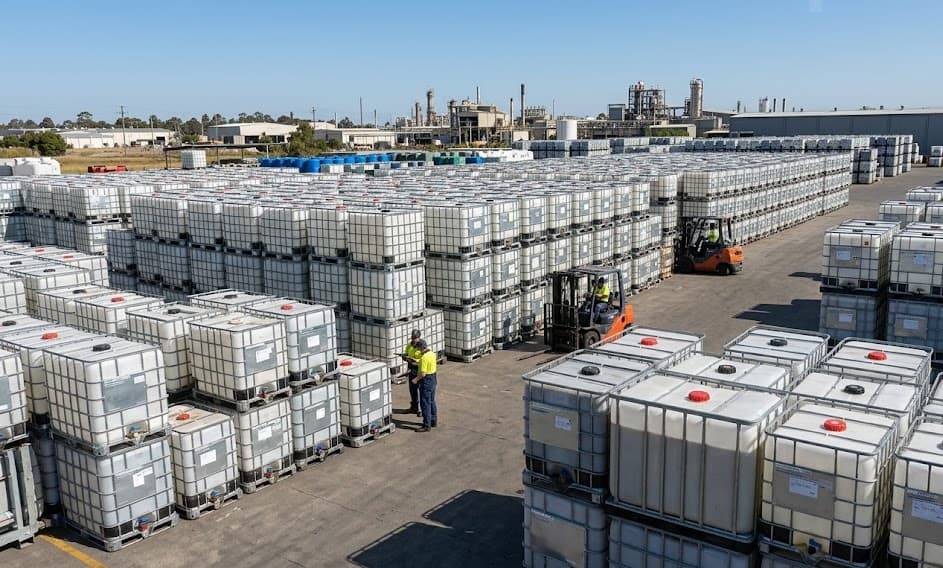
Zero-waste manufacturing — the goal of sending no waste to landfills — is moving from aspirational concept to operational reality for a growing number of manufacturers. While most zero-waste conversations focus on production processes, raw material efficiency, and packaging design, the containers used to receive raw materials and ship finished products represent a significant and often overlooked waste stream. IBC totes, which flow through manufacturing supply chains by the millions, are a prime target for zero-waste management, and the recycling infrastructure that supports them is a critical enabler of landfill-free operations.
The typical manufacturing facility receives raw materials in IBC totes, uses those materials in production, and generates empty containers that need to be managed. In a linear economy, those empty totes would be treated as waste — hauled to a dumpster, compacted, and sent to a landfill. The environmental cost of that approach is substantial: each landfilled tote represents approximately 50 to 70 pounds of HDPE plastic, 30 to 50 pounds of steel, and a wooden or plastic pallet base, all of which are perfectly recyclable materials being permanently removed from productive use.
In a zero-waste approach, those same empty totes enter a managed end-of-use pathway. The first priority is reuse. If the totes are in good condition and the previous contents are compatible with future use, they can be cleaned, reconditioned, and returned to service. This is the highest-value outcome because it preserves the embedded energy and materials of the entire container, avoids the manufacturing impact of a replacement, and generates economic returns through resale value. A manufacturer that sells its empty totes to a reconditioner like Cleveland IBC Recycling generates revenue from what would otherwise be a waste disposal cost — turning a negative line item into a positive one.
The second priority is component reuse. If the inner bottle is degraded but the steel cage and pallet base are still sound, the tote can be rebottled — the old bottle is removed and recycled, and a new bottle is installed in the existing cage and pallet assembly. This extends the life of the most durable components and reduces the volume of material that needs to be recycled.
The third priority is material recycling. When a tote has truly reached end of life and no component can be economically reused, the container is disassembled and each material stream is sent to the appropriate recycling facility. The HDPE bottle is shredded, washed, and pelletized into recycled resin. The steel cage goes to a metal recycler for melting and recasting. Wooden pallets are chipped for mulch or biomass fuel. Plastic pallets are ground and recycled alongside the bottle material. When done properly, this process achieves a material recovery rate approaching 100 percent — meaning virtually nothing goes to landfill.
For manufacturers pursuing zero-waste certification through programs like TRUE (Total Resource Use and Efficiency) by Green Business Certification Inc., UL 2799 Zero Waste to Landfill certification, or their own internal sustainability targets, IBC container management is a line item that must be addressed. These certification programs require that at least 90 percent (TRUE Zero Waste) or 100 percent (Platinum level) of waste be diverted from landfills through a combination of reuse, recycling, composting, and energy recovery. IBC totes, due to their weight and volume, represent a meaningful fraction of many manufacturers' total waste streams, and diverting them from landfill makes a measurable contribution to the overall diversion rate.
The documentation aspect of IBC recycling is particularly valuable for zero-waste programs. Reputable recyclers provide certificates of recycling that document the quantity of material processed, the recycling methods used, and the downstream destinations of the recovered materials. These certificates plug directly into waste diversion tracking systems and sustainability reports, providing the auditable evidence that certification programs and stakeholders require.
Beyond the direct waste diversion benefits, IBC recycling supports zero-waste manufacturing indirectly by reducing the total number of containers that need to be manufactured. Every tote that gets reconditioned and reused instead of scrapped and replaced avoids the raw material extraction, energy consumption, water use, and waste generation associated with manufacturing a new container. This upstream impact multiplies the environmental value of each reconditioning cycle and aligns with the zero-waste philosophy that the best waste is the waste that never gets generated in the first place.
The logistics of integrating IBC recycling into a zero-waste manufacturing program are straightforward. Start by inventorying your facility's IBC tote flows — how many totes come in, what they contain, how many go out empty, and what currently happens to the empties. Then establish a relationship with a local IBC reconditioner and recycler who can pick up your empty totes on a regular schedule, recondition the ones that are suitable for resale, and recycle the rest. Set up a tracking system to document the quantity and disposition of every tote that leaves your facility. And integrate the tote management data into your overall waste diversion metrics.
Cleveland IBC Recycling works with manufacturers across Northeast Ohio to implement exactly this kind of program. We provide scheduled pickup service, transparent processing documentation, and the certificates of reconditioning and recycling that zero-waste programs require. Whether your facility generates 10 totes per month or 500, we can design a container management program that supports your waste elimination goals.
The zero-waste movement is growing because it makes both environmental and economic sense. Waste is inefficiency, and eliminating waste reduces costs while improving environmental performance. IBC recycling is one of the simplest and most impactful waste elimination strategies available to manufacturers that rely on bulk liquid containers. If your facility is working toward zero waste and has not yet addressed its IBC tote stream, that is low-hanging fruit worth picking.